
Table of Contents
- Can You Use Niacinamide and Peptides Together?
- Niacinamide Before Peptide Serum: The Order That Works
- How to Layer Serums in a Skincare Routine, Step by Step
- How Long to Wait Between Skincare Serums
- Matching the Routine to Your Skin Type and Sensitivity
- Troubleshooting Pilling, Irritation and Product Conflicts
- Building Your Layering Routine with Regnal Radiance
- Frequently Asked Questions
Last Updated: October 25, 2026
Can You Use Niacinamide and Peptides Together?
Yes, you can use niacinamide and peptides together. The two ingredients do not cancel each other out, and most skin types tolerate them in the same routine. This guide from Regnal Radiance explains how to layer niacinamide and peptide serum so each one absorbs properly and your skin barrier stays calm.
The pairing works because the two ingredients do different jobs. Niacinamide supports the skin barrier and helps balance oil. Peptides are short chains of amino acids that signal skin to support its own renewal. One calms and balances. The other rebuilds. Neither blocks the other.
What most guides get wrong is the order. Get that right and the rest is simple.
Why the Pairing Works for Sensitive Skin
Sensitive skin reacts to strength, not to ingredients alone. A high-strength niacinamide serum can sting. A peptide serum with a light texture rarely does. The problem is usually concentration and how fast you add a new product.
The American Academy of Dermatology's guidance on skin care points to gentle cleansing and gradual product introduction as the basics of a calm routine. That advice matters here. Start with one serum at a low frequency, then add the second.
A common mistake is buying both serums and starting them on the same night. If your skin reacts, you won't know which one caused it.
If gentle products still irritate your skin, our article on why gentle skincare irritates sensitive skin explains the usual causes before you add another active.
Niacinamide Before Peptide Serum: The Order That Works
Apply niacinamide first, then peptide serum. Niacinamide serums are usually water-based and thin. Peptide serums are often slightly richer. Thin textures go on before thicker ones so they can absorb.
Here is the decision rule we recommend:
- Read the ingredient list and texture of each serum.
- Apply the thinner, more watery formula first.
- Apply the richer formula second.
- Follow with moisturizer to seal both in.
If both serums feel identical in texture, niacinamide goes first. It is the more common water-based formula, and it sits well on clean, slightly damp skin.
The exact phrase to remember: niacinamide and peptide serum order follows texture, not brand loyalty. That single rule solves most layering questions.
How to Layer Serums in a Skincare Routine, Step by Step
Layering serums means applying products from thinnest to thickest so each one absorbs before the next goes on. The sequence below works for most water-based niacinamide and peptide serums, but treat it as a default you adjust to your actual products.
Evening routine (the simpler place to start):
- Cleanse. Use a gentle, non-stripping cleanser. Pat dry but leave skin slightly damp, damp skin helps water-based serums spread and absorb.
- Apply niacinamide serum. Use about a pea-sized amount (roughly 1/4 teaspoon) for the face and neck. Dot it across the forehead, cheeks, and chin, then smooth, don't rub hard.
- Wait 1-2 minutes. You don't need a long pause. Move on when the serum feels tacky rather than wet.
- Apply peptide serum. Use a similar amount. Press it in gently with your palms rather than dragging.
- Follow with moisturizer. This seals in water and supports the barrier. A gel-cream suits oily skin; a richer cream suits dry skin.
Morning routine:
- Cleanse (or rinse with water if your skin is dry or sensitive).
- Niacinamide serum.
- Peptide serum.
- Moisturizer.
- Sunscreen as the final step. Use a broad-spectrum SPF 30 or higher and apply enough to cover the face and neck, about two finger-lengths is a common guide.
Where the order can change: If your peptide serum is noticeably thinner and more watery than your niacinamide serum, apply the peptide first. The texture rule beats the ingredient rule. Check the product instructions too, some peptide formulas are designed to go on before other serums, and some niacinamide products are gels that absorb faster than a watery peptide.
How much to use: More is not better with serums. Over-applying is a leading cause of pilling and a heavy feel. A pea-sized amount per serum is enough for most faces; adjust slightly for neck and jawline coverage.
Frequency: If you're new to either ingredient, start with one serum every other night for one to two weeks, then add the second. Once both are tolerated, you can use them daily, morning and evening, unless a product's instructions say otherwise.
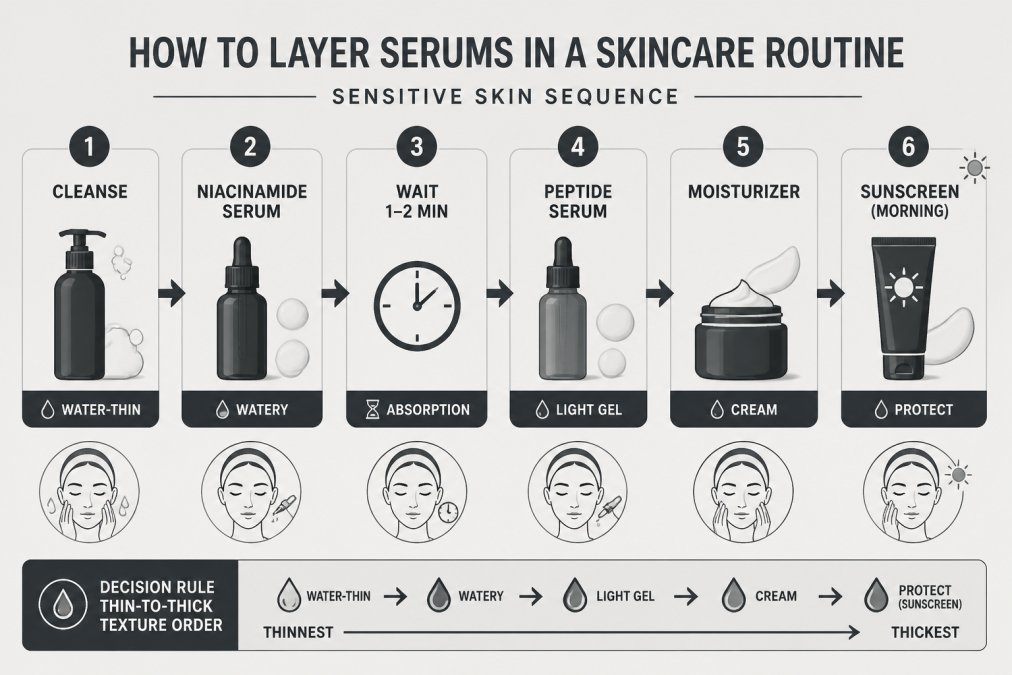
If you want a shorter version of this process, our simple skincare routine for busy people trims it to the steps that matter most.
Here is the default layering sequence the article recommends, from cleanse to sunscreen.
| Step | What to do | Time or frequency |
|---|---|---|
| Cleanse | Gentle, non-stripping cleanser; leave skin slightly damp | Every routine |
| Niacinamide serum | Pea-sized amount (roughly 1/4 teaspoon) for face and neck | Every other night for one to two weeks when new |
| Wait | Move on when serum feels tacky, not wet | 1-2 minutes |
| Peptide serum | Similar amount; press in gently with palms | Add after first serum is tolerated |
| Moisturizer | Gel-cream for oily skin; richer cream for dry skin | Every routine |
| Sunscreen | Broad-spectrum SPF 30 or higher, about two finger-lengths | Morning routine, final step |
How Long to Wait Between Skincare Serums
Wait about one to two minutes between serums. You do not need a long pause. Wait until the first serum feels dry to the touch, then apply the next one.
A common mistake is rushing. If the niacinamide serum is still wet, the peptide serum will slide around instead of absorbing. Pilling follows.
Signs you waited long enough:
Anti-Aging Peptide Collection →
- The skin feels tacky, not wet
- No visible shine or pooling
- The next product spreads evenly
If your products pill, wait a little longer. Texture, not the clock, is your guide.
Matching the Routine to Your Skin Type and Sensitivity
Skin type changes how you layer, not whether you can. The two serums stay in the routine; what changes is the moisturizer, the frequency, and how much you use.
Sensitive skin. Start with one serum, usually the peptide, since it's less likely to sting, every other night for one to two weeks. Add the niacinamide serum only after the first is tolerated. Keep both layers thin, and choose a fragrance-free moisturizer. If niacinamide stings, check the concentration: many people tolerate 2-5% niacinamide well but react to 10% or higher. A lower-strength formula is often the fix, not abandoning the ingredient.
Dry skin. Use a richer moisturizer or a moisturizer with ceramides on top of both serums. Apply the peptide serum to slightly damp skin to help it spread, and don't skip the evening moisturizer, dry skin pills more easily when layers are under-moisturized.
Oily and acne-prone skin. Choose lightweight, water-based formulas and a gel moisturizer. Niacinamide is often well tolerated here, but if your acne treatment (benzoyl peroxide, salicylic acid, adapalene) is already drying, introduce the serums on alternate nights rather than stacking everything at once. Keep leave-on acids in a separate step or evening if your skin is reactive.
Patch testing that actually tells you something. Apply a small amount behind the ear or on the inner forearm and leave it for 24 hours. If there's no redness, itching, or stinging, try it on a small area of the jawline for two to three nights before using it on the full face. Testing one new product at a time is the only way to know which one caused a reaction.
Concentration and formulation matter more than the order. A 10% niacinamide serum and a 2% one behave differently on sensitive skin. A peptide serum that already contains niacinamide means you may not need a separate niacinamide step. Read the ingredient list: if a product already combines the two, layering a second serum of the same ingredient adds irritation risk without clear benefit. When in doubt, use the lower-strength product first and build up.
If your skin is reactive, our guide to effective anti-aging for sensitive skin covers how to build a full routine without triggering flare-ups.
The Anti-Aging Peptide Collection from Regnal Radiance includes a peptide serum, an eye cream, and an AM/PM cream. The serum is designed to go on clean skin before the cream, which fits the order above. You can see the full Anti-Aging Peptide Collection if you want the serum and moisturizer matched.

Troubleshooting Pilling, Irritation and Product Conflicts
Pilling usually means too much product or too little wait time. Use less serum and give each layer a moment to settle. Applying a heavy cream over a wet serum is the other common cause.
Irritation has a few usual suspects:
- A high-strength niacinamide serum
- Adding two new products at once
- Over-cleansing before serums
Scale back to one serum, then reintroduce the second slowly. If redness persists, stop the new product and check the ingredient list. Our guide on how to identify hidden irritants in skincare walks through the labels to read first.
Watch out: mixing a strong acid into the same layer as your peptide serum can sting sensitive skin. Keep acids for a separate evening if you use them at all.
Building Your Layering Routine with Regnal Radiance
A layering routine only works if you can repeat it. Two serums, one moisturizer, and one sunscreen cover most needs. Add nothing else until that basic order feels automatic.
At Regnal Radiance, our formulas are built with clean ingredients and no unnecessary additives. The Bioactive Prebiotics Jelly Serum is a lightweight, water-based option that absorbs quickly, which makes it an easy first layer before a peptide serum. It is designed to support the skin barrier and soothe redness.
Both products suit all skin types, including sensitive and dehydrated skin. That matters when you are layering, because a calm base makes the next step easier.
Frequently Asked Questions
What should I apply first, niacinamide or peptide serum?
Apply the niacinamide and peptide serum in thin-to-thick order. Niacinamide serums are usually water-based and lightweight, so they go on first, right after cleansing. Peptide serums often carry a slightly richer texture and go second so the peptides sit closer to the skin surface. If your peptide serum is the thinner of the two, swap them: texture decides, not the ingredient name. Pat each layer in gently and give it a moment to absorb before the next step.
Can I use niacinamide and peptide serum together every day?
Yes, the two ingredients work well in the same routine, but start slowly if your skin is sensitive. Begin with niacinamide every other night for one to two weeks, then add the peptide serum on the nights in between. Once your skin feels calm and comfortable, move both to daily use. A pea-sized amount of each is enough. If you notice stinging or redness, drop back to every other night and rebuild tolerance gradually.
How long should I wait between niacinamide and peptide serum?
You usually do not need a long wait. Give the niacinamide serum 30 to 60 seconds to absorb, or until the skin feels tacky rather than wet, then apply the peptide serum. Thicker formulations may need closer to two minutes. There is no clinical reason to wait ten or fifteen minutes between these two ingredients. If products start to pill or roll off, that is your signal to wait a little longer or use less of each.
What should I avoid layering with niacinamide and peptides?
Avoid stacking strong acids, high-strength retinoids and vitamin C in the same layer as niacinamide, especially on sensitive skin. These actives can raise the risk of irritation when used together. Peptides are gentler but do not pair well with direct acids, which can break down their structure. Keep exfoliating acids to one or two evenings a week, use them on a night when you skip the peptide serum, and always follow with moisturizer and morning sunscreen.
Layering two serums should not feel like a puzzle. If you want a routine where the order is already worked out, start with the Anti-Aging Peptide Collection and add a prebiotic serum as your first layer. Get started with Regnal Radiance and build a routine your skin can actually keep up with.
