
Last Updated: October 23, 2026
Quick Summary
Gentle skincare irritates sensitive skin because "gentle" is a marketing word, not a regulated claim, so formulas can still contain fragrance, drying alcohol, or strong preservatives. A product described as gentle or intended for sensitive skin can still irritate an individual, since the label alone does not establish that it will suit every person.
- Read the full ingredient list, not the front of the bottle, because fragrance sits in small type near the bottom.
- Cumulative irritation is the slow build-up of damage from several mild products used together.
- Cut back to a cleanser, a moisturizer, and one treatment, and add new products one at a time.
- Stop all new products for two weeks before patch testing so your skin settles to a known baseline.
- Stop all actives immediately during an active reaction and return to gentle cleansing and moisturizing.
Table of Contents
- Why Gentle Skincare Irritates Sensitive Skin: The Label Trap
- Skin Barrier Damage Symptoms You Might Be Missing
- Ingredients to Avoid for Sensitive Skin (Even in "Clean" Formulas)
- Cumulative Irritation: How Products Interact and Overuse Backfires
- Patch Testing Skincare Products: A Step-by-Step Plan
- How to Calm Irritated Sensitive Skin During an Active Reaction
- Irritation vs. Allergy: How to Tell the Difference
- Frequently Asked Questions
Why Gentle Skincare Irritates Sensitive Skin: The Label Trap
According to Farage et al.'s prevalence study on sensitive skin, 78% of people with unusually sensitive skin have avoided specific products because of a bad reaction. Yet most of those abandoned bottles were labeled "gentle." At Regnal Radiance, we hear the same story constantly: a drawer full of products that promised calm and delivered stinging instead.
The problem is not you. The problem is what "gentle" means on a label, which is close to nothing.
What "gentle" actually means on a label
"Gentle" is a marketing word, not a regulated claim. No standard defines how mild a product must be to earn it, so a formula can carry the word while still containing fragrance, drying alcohol, or strong preservatives.
A product described as gentle or intended for sensitive skin can still irritate an individual. The label alone does not establish that a product will suit every person.
The 78% statistic that explains your drawer of abandoned products
That 78% figure is the clearest evidence that "sensitive skin friendly" labels fail in practice. People are not imagining reactions. They are reacting to real ingredients, and then blaming themselves.
A review of sensitive skin research identifies cosmetics as major triggers, particularly in women, and links this partly to overuse or inappropriate use. In other words, the products and how we apply them both matter.
Skin Barrier Damage Symptoms You Might Be Missing
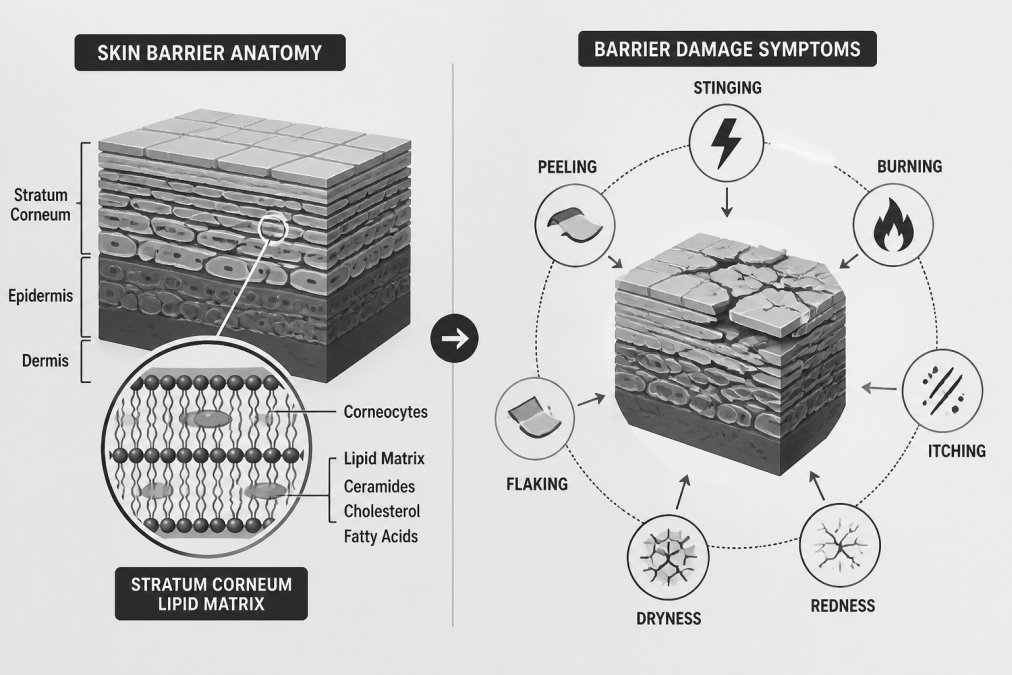
Skin barrier damage shows up as stinging, burning, itching, redness, dryness, and flaking. These are signs that the outer layer of skin has lost some of its ability to hold water and keep irritants out.
Here is what each signal usually means:
- Stinging or burning: a reaction within seconds of applying a product, often to fragrance, alcohol, or acids
- Itching: a common sign of irritation or a developing allergy
- Redness: visible inflammation, sometimes delayed by hours
Ingredients to Avoid for Sensitive Skin (Even in "Clean" Formulas)
The most common irritants are fragrance, essential oils, alcohol, propylene glycol, and some preservatives. All of them appear in products marketed as clean, natural, or gentle.
Fragrance, essential oils, alcohol, and preservatives
Fragrance is the single most common trigger, and "fragrance-free" is not always what it seems. Some products labeled fragrance-free still contain masking scents. Essential oils such as lavender and citrus are natural fragrances, and they irritate reactive skin just as readily.
Alcohol and ethanol give a light, fast-drying feel but strip moisture from the barrier. Propylene glycol and some preservatives cause contact reactions in a minority of people.
Why "natural" does not mean non-irritating
According to Stanford Medicine's report on natural skin products, common soaps, serums, and lotions, including products people hope will soothe painful skin, can trigger or worsen irritation.
Natural is a sourcing claim, not a safety claim. Poison ivy is natural.
For a deeper checklist of what to screen out, read our guide to ingredients to avoid for sensitive skin, and if you want help reading real labels, see how to identify hidden irritants in skincare.
Cumulative Irritation: How Products Interact and Overuse Backfires
Cumulative irritation is the slow build-up of damage from several mild products used together. Each one seems fine alone.
This is the part most routines get wrong. A cleanser, a toner, a serum, and a moisturizer can each be low-irritation on their own.
The review linking cosmetics to sensitive skin points to overuse and inappropriate use as key factors. More steps is not more results.
- Cut back to a cleanser, a moisturizer, and one treatment
- Add new products one at a time, never three at once
- Give your skin two weeks before judging a product
Patch Testing Skincare Products: A Step-by-Step Plan
Patch testing means applying a small amount of a product to a small area and watching for a reaction before using it widely. It is the most reliable at-home way to find out whether a product suits your skin, but only if you test correctly and know how to read the result.
The at-home patch test protocol
- Stop all new products for two weeks so your skin settles to a known baseline. Testing on top of an active reaction tells you nothing.
- Choose one product at a time. Never test two new products in the same window.
- Apply a small amount, about the size of a pea, to the inner forearm or behind the ear. Use the product exactly as you would on your face (don't dilute it).
- Leave it uncovered and unwashed for 48 hours. Check at 24 and 48 hours for redness, itching, bumps, or burning.
- If there is no reaction, repeat on the jawline for three consecutive days. The face is thinner and more reactive than the forearm, so a product that passes the arm can still fail the face.
- Introduce one product at a time, waiting two weeks between additions, and keep a simple log of dates, products, and symptoms.
How to interpret what you see
- Reaction within minutes to an hour (stinging, burning, redness): this is most likely irritation, not allergy. The product may be too strong for your barrier right now, set it aside and revisit only after your skin has calmed.
- Reaction at 24-72 hours (itching, bumps, a spreading rash): this pattern is more consistent with an allergic response. Stop the product and do not retest it.
- No reaction at 48 hours but a reaction on day 4-5 of facial use: delayed reactions exist. Treat any new symptom during the first two weeks of use as a possible signal and stop.
Limitations worth knowing
A home patch test is a screening tool, not a diagnosis.
A common mistake is testing several products at once. If a reaction appears, you will not know which one caused it, and you will have to start over.
If you need a genuinely mild cleanser to start with, our Gentle Cleansing Milk is formulated with shea butter and argan oil for normal, mature, and dry skin.

How to Calm Irritated Sensitive Skin During an Active Reaction
Stop all actives immediately and return to a bare routine of gentle cleansing and moisturizing. Most mild irritation settles within a week once the trigger is removed.
Do this:
- Drop retinoids, acids, scrubs, and anything with fragrance
- Cleanse with lukewarm water and a mild cleanser
- Moisturize while skin is still slightly damp
Our Sensitive Skin Body Cream is built for exactly this moment: a fast-absorbing formula with aloe juice, shea butter, and cocoa butter that hydrates without redness or tightness. For a full routine, follow our 7-step guide to soothing reactive skin.

If swelling, blistering, or spreading rash appears, see a doctor rather than treating it at home.
Irritation vs. Allergy: How to Tell the Difference
Irritation causes stinging, burning, or redness soon after contact and stays in the area where the product was applied. Allergy causes itching, swelling, or a rash that can spread, and it often appears hours or days later. The two can look similar at first, but the pattern, timing, location, and what happens when you stop, is the clue.
Irritant contact dermatitis
This is a direct chemical injury to the skin. It does not involve the immune system, so it can happen to anyone if the dose or exposure is high enough. Common culprits include acids, alcohol, fragrance, and repeated exposure to water and surfactants.
- Timing: minutes to hours after contact
- Distribution: confined to where the product was applied, often with a clear edge
- Symptoms: stinging, burning, redness, dryness, tightness
Allergic contact dermatitis
This is an immune response. It requires prior sensitization, you can use a product for months or years with no problem, then suddenly react. Once allergic, you stay allergic, and even tiny amounts can trigger a flare.
- Timing: often 24-72 hours after contact, sometimes longer
- Distribution: can spread beyond the application site, and may appear on the eyelids, neck, or hands after touching the face
- Symptoms: itching, bumps, blisters, weeping, swelling
When to stop and when to seek care
Stop the suspected product immediately in either case. Most mild irritation settles within a week of removal. See a doctor if you have swelling, blistering, a rash that spreads or weeps, symptoms that worsen after 48 hours of stopping, or a reaction that keeps returning without an obvious cause. A dermatologist can perform proper patch testing to identify the specific allergen, something an at-home test cannot do.
The pattern of timing, location, and what happens when you stop is the clue that separates the two.
| Feature | Irritant contact dermatitis | Allergic contact dermatitis |
|---|---|---|
| Timing | Minutes to hours after contact | Often 24-72 hours after contact, sometimes longer |
| Distribution | Confined to where the product was applied, often with a clear edge | Can spread beyond the application site |
| Symptoms | Stinging, burning, redness, dryness, tightness | Itching, bumps, blisters, weeping, swelling |
| Course | Improves within days once trigger removed | Can persist one to two weeks after stopping |
| Repeat exposure | Same reaction each time, may worsen with continued use | Returns every time, often more quickly and severely |
Frequently Asked Questions
Why is my skincare suddenly irritating my skin when it never did before?
Products that worked for months can start stinging because of cumulative irritation. Repeated use of fragrances, retinoids, ethanol, or propylene glycol can wear down the skin barrier over time, and the reaction appears once tolerance runs out. Overuse and inappropriate use are cited as major drivers of sensitive-skin reactions to cosmetics. Stop the suspect product, simplify to a mild cleanser and moisturizer for two weeks, then reintroduce one item at a time to find the trigger.
Can fragrance-free or natural skincare still irritate sensitive skin?
Yes. "Fragrance-free" and "natural" are not guarantees. Stanford Medicine reports that common soaps, serums, and lotions, including products people hope will soothe painful skin, can trigger or worsen irritation. Essential oils, plant extracts, and some preservatives are frequent culprits even in clean-labeled formulas. The label describes positioning, not your individual tolerance. Patch test any new product on the inner forearm for 48 hours before applying it to your face.
How can I tell whether a skincare product is causing irritation or an allergy?
Irritant contact dermatitis tends to stay where the product touched your skin and feels like stinging, burning, or dryness. Allergic contact dermatitis often spreads beyond the application site, appears 24 to 72 hours later, and may include swelling or a rash. If a reaction spreads or persists after stopping the product, see a dermatologist. For everyday troubleshooting, patch testing skincare products one at a time is the most reliable way to link a symptom to a specific formula.
What should I do if my skin burns or stings after applying a gentle product?
Rinse with lukewarm water, skip all actives and fragranced products, and apply a plain, soothing moisturizer. A formula with prebiotics and hyaluronic acid, such as the Microbiome Prebiotics Face Mist, can help restore the barrier while you recover. Avoid harsh scrubs and hot water. If burning lasts more than a few days, spreads, or blisters, seek medical advice. Once calm, reintroduce products slowly using a patch test to confirm which one caused the reaction.
