
Table of Contents
- Why a Simple Skincare Routine Works for Busy Schedules
- The Five-Minute Skincare Routine: What You Actually Need
- Your Simple Morning Skincare Routine
- Your Simple Nighttime Skincare Routine
- Skincare Routine Order: Layering Products Correctly
- Building a 5-Minute Skincare Routine Without Skipping Results
- Adapting Your Routine for Your Skin Type and Concerns
- Common Mistakes That Waste Time and Damage Results
- Frequently Asked Questions
Last Updated: October 12, 2026
Why a Simple Skincare Routine Works for Busy Schedules
A simple skincare routine for busy people isn't about cutting corners, it's about cutting clutter. Strip away the unnecessary steps and you're left with what actually moves the needle: cleansing, treating, moisturizing, and protecting.
Most people are overwhelmed by 10-step routines they assume are the baseline. They're not. Three to five intentional steps beat a complicated routine you'll abandon in two weeks.
At Regnal Radiance, we believe that radiance is built through intentional daily practices.
A five-minute skincare routine isn't a shortcut; it's a repeatable system. Do the same thing every morning and night, and your skin responds.
The Five-Minute Skincare Routine: What You Actually Need
You don't need serums, essences, toners, masks, and eye creams for healthy skin. You need:
- A gentle cleanser
- A lightweight serum or treatment (optional but helpful)
- A moisturizer
- Sunscreen (mornings only)
That's it. These four steps handle 95% of what your skin needs. Everything else is a bonus.
A five-minute routine works because it removes decision fatigue, you know exactly what comes first, second, third, and fourth.
Consistency matters more than complexity: three products used consistently beat ten used sporadically. Your skin responds to what you do every day, not occasionally.
Choose products that do their job well: a gentle cleanser that removes makeup without stripping, a moisturizer that hydrates without heaviness, a sunscreen that protects without a white cast.
Your Simple Morning Skincare Routine
Start your morning skincare routine with cleansing to remove overnight impurities.
Step 1: Cleanse (1 minute)
The Gentle Cleansing Milk from Regnal Radiance works well here because it gently cleanses away makeup and impurities.

Step 2: Apply Treatment or Serum (1 minute)
While skin is still slightly damp, apply a lightweight serum. Optional, but it helps skin absorb moisture more effectively.
The Bioactive Prebiotics Jelly Serum absorbs quickly and supports your skin's natural barrier before moisturizer.
Step 3: Moisturize (1 minute)
Apply moisturizer to damp skin to lock in hydration, using upward motions and avoiding the delicate eye area.
The Moisturizing Day Cream delivers all-day hydration that actually lasts.
Step 4: Apply Sunscreen (2 minutes)
Sunscreen is non-negotiable, sun damage is cumulative and irreversible. Apply it last, after moisturizer absorbs.
Use enough to cover your entire face and neck, most people use too little. The Sun Protection SPF50 Stick is portable and blends smoothly.
Your Simple Nighttime Skincare Routine
Your nighttime skincare routine has more flexibility since you're not applying makeup or heading outside.
Step 1: Cleanse (1 minute)
Use the same gentle cleanser as your morning routine to remove makeup, sunscreen, and the day's grime.
Cleansing at night removes a full day of environmental exposure so your skin gets a fresh start before sleep.
Step 2: Apply Treatment or Serum (1 minute)
Use the same serum as the morning, or something richer if your skin needs it. The Bioactive Prebiotics Jelly Serum works morning and evening.

Step 3: Moisturize (1 minute)
Use your regular moisturizer, or a richer night cream if your skin is dry, at night your skin is in repair mode.
Step 4: Optional Targeted Treatment (1 minute)
Add a mask or targeted treatment only if you have specific concerns. It's truly optional, your basic routine is complete without it.
Skincare Routine Order: Layering Products Correctly
Application order affects how well products work. Apply from thinnest to thickest consistency.
The Basic Rule: Thinnest to Thickest
Water-based products go on first, oil-based last, so each absorbs before the next sits on top.
Here's the correct order:
- Cleanser (removes everything)
- Toner or essence (optional, hydrates)
- Serum or treatment (lightweight, active ingredients)
- Moisturizer (locks in hydration)
- Sunscreen (AM) or night cream (PM)
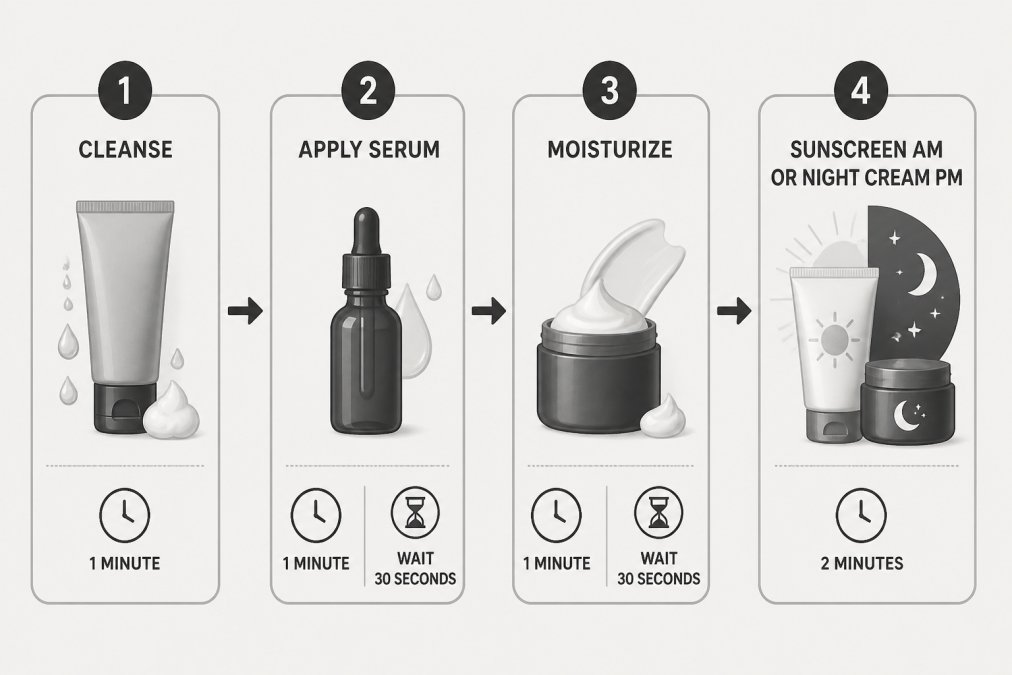
Wait Times Between Products
You don't need to wait hours between steps, but give each product a moment to absorb before the next layer.
- After cleansing: 30 seconds
- After serum: 30 seconds to 1 minute
- After moisturizer: 2-3 minutes before sunscreen
These wait times prevent pilling and ensure each layer absorbs properly.
Why Order Matters
If you apply sunscreen before your moisturizer, the sunscreen sits on top and doesn't bond to your skin properly. If you apply a thick cream before a lightweight serum, the serum can't penetrate. The order determines whether your products work or just sit on the surface.
Building a 5-Minute Skincare Routine Without Skipping Results
The biggest fear people have is that a simple routine won't be enough. The reality is that a focused routine with good products can be highly effective.
Choose Quality Over Quantity
Spend your money on products that actually work rather than on more products. One excellent moisturizer beats three okay ones.
The products you choose should address your specific skin concerns. If your skin is dry, prioritize hydration. If it's sensitive, prioritize calming and barrier support.
Know Your Non-Negotiables
For a busy person, your non-negotiables are:
- A cleanser that removes impurities without stripping
- A moisturizer that keeps your skin hydrated
- Sunscreen for daytime protection
Everything else is optional. A serum helps, but it's not required. A night cream is nice, but your regular moisturizer works too.
Make It a Habit, Not a Chore
The best routine is the one you'll actually do. If a five-minute routine feels sustainable, stick with it. If you have five extra minutes and want to add a serum or mask, that's a bonus.
Consistency matters more than perfection. Doing the basics every single day beats doing an elaborate routine three times a week.
Adapting Your Routine for Your Skin Type and Concerns
Your four-step routine stays the same. What changes is the type of product you plug into each step. Below is a practical way to adjust without adding steps, plus the one concern-specific addition worth making if you have five extra minutes.
The essentials-vs-optional rule
For every skin type, three steps are non-negotiable: a gentle cleanser, a moisturizer, and morning sunscreen. The serum is optional. If you only have three minutes, drop the serum, not the sunscreen. This is the single most useful prioritization rule for a busy schedule, and it's the one most routines skip.
Dry skin
- Cleanse: a milk or cream cleanser that doesn't foam heavily. Foaming agents can strip the lipid barrier, which is why dry skin often feels tight right after washing.
- Moisturize: a cream with occlusives (like squalane or shea) to slow water loss, plus humectants (like glycerin or hyaluronic acid) to pull water in.
- Optional serum: a hydrating serum applied to damp skin, before moisturizer, to trap that water.
Oily or combination skin
- Cleanse: a gentle gel cleanser. Resist the urge to use a harsh, squeaky-clean formula, over-drying triggers rebound oil production.
- Moisturize: a lightweight, non-comedogenic gel or lotion. Don't skip moisturizer on oily skin; dehydrated skin often overproduces oil.
- Optional serum: a niacinamide serum, which most practitioners find helps with oil balance and pore appearance over several weeks.
Sensitive or reactive skin
- Cleanse: fragrance-free, minimal-ingredient cleanser. Fragrance and essential oils are common triggers.
- Moisturize: a barrier-supporting cream with ceramides or panthenol.
- Optional serum: skip actives entirely at first. Add one product at a time, and patch-test on your inner forearm for 24-48 hours before using it on your face.
Acne-prone skin
- Cleanse: gentle, twice daily, no scrubbing. Over-washing irritates acne rather than clearing it.
- Moisturize: oil-free, non-comedogenic lotion. Acne treatments dry the skin, so moisturizer is not optional here.
- Optional treatment: a leave-on salicylic acid (BHA) product, 2-3 nights per week to start. See the section on introducing actives safely below.
Mature skin
- Cleanse: a creamy, non-stripping cleanser.
- Moisturize: a richer cream, especially at night when the skin's repair cycle is most active.
- Optional serum: an antioxidant serum in the morning (like vitamin C) if you want extra support. Introduce it slowly and always under sunscreen.
When to see a professional
A simple routine handles everyday maintenance. It does not replace medical care. If you have persistent cystic acne, sudden changes in a mole, severe redness or swelling, or a rash that doesn't improve with gentle care, see a dermatologist rather than adding more products. No over-the-counter routine is a substitute for a diagnosis.
Common Mistakes That Waste Time and Damage Results
Most "skincare mistakes" lists repeat the same warnings without explaining why the mistake matters or how often it actually causes a problem.
1. Introducing actives too fast
Retinoids, AHAs, BHAs, and vitamin C are all effective, but they can irritate skin when introduced too quickly. A safe pattern to consider:
- Start with one active at a time. Don't stack a new retinoid and a new acid in the same week.
- Use it 2 nights per week for the first two weeks, then 3 nights, then every other night, only increasing if your skin stays calm.
- Apply the active to dry skin, then moisturize on top (the "buffering" method) to reduce irritation.
- Patch-test any new active on your inner forearm for 24-48 hours before putting it on your face.
- If you get stinging, peeling, or redness that lasts more than a day, stop and let your skin recover before restarting at a lower frequency.
2. Skipping sunscreen on cloudy days or indoors
UV exposure is cumulative, and UVA passes through clouds and window glass.
3. Over-cleansing
Washing more than twice a day, or using a harsh foaming cleanser, can strip the skin. The result can be tightness, then rebound oil, then irritation.
4. Layering products too fast
If you apply the next product before the previous one has absorbed, you get pilling, tiny balls of product that roll off your skin.
5. Using too much product
A pea-sized amount of serum and a nickel-sized amount of moisturizer cover the whole face and neck.
6. Switching products too often
Skin turnover takes roughly four weeks, and visible improvement from most actives takes 6-8 weeks.
7. Treating your routine as a project instead of a habit
Busy people don't fail at skincare because they chose the wrong serum. They fail because the routine was too long to survive a bad week.
Frequently Asked Questions
What is the simplest skincare routine for busy people?
A simple skincare routine for busy people consists of four essential steps: cleanse, treat with a serum or targeted treatment, moisturize, and apply sunscreen in the morning (or night cream at night). This takes about five minutes and covers all the basics your skin needs to stay healthy and protected. The key is choosing quality products that do multiple jobs, so you're not layering on unnecessary steps.
Can you build an effective skincare routine with just three products?
Yes. The three non-negotiable steps are gentle cleansing, hydration with a moisturizer, and sun protection during the day. If you want to add one targeted treatment like a serum to address specific concerns such as dryness or sensitivity, that becomes a four-step routine. The Gentle Cleansing Milk removes impurities without stripping skin, the Moisturizing Day Cream delivers lasting hydration, and the Sun Protection SPF50 Stick provides essential UV defense, these three cover your foundation.
How long does a simple skincare routine take?
A simple skincare routine takes approximately five minutes from start to finish. This includes one to two minutes for cleansing, one minute for applying a serum or treatment, one to two minutes for moisturizer, and one minute for sunscreen or night cream. The speed depends on how quickly your products absorb and how much you massage them in, but most people can complete the entire routine in one sitting.
How can beginners add anti-aging products to a simple routine?
Start by introducing one active ingredient at a time, such as a hydrating serum with hyaluronic acid or a prebiotic formula that strengthens your skin barrier. Apply it after cleansing and before moisturizer, waiting 30-60 seconds for it to absorb. The Bioactive Prebiotics Jelly Serum is designed for all skin types and works alongside your moisturizer to support skin health and promote a radiant, healthy-looking glow. Begin using it two to three times per week, then increase frequency as your skin adjusts.