
Table of Contents
- Why Hidden Irritants Matter: Understanding Skin Reactions
- Common Skincare Ingredients That Trigger Irritation
- Recognize Skincare Allergy Symptoms and Irritation Signs
- How to Read Skincare Ingredient Labels and Spot Risky Names
- Use a Skincare Ingredient Checker App to Assess Risk
- Step-by-Step: How to Patch Test Skincare Products
- Isolate the Culprit: A Product-Tracking Method
- When to Seek Professional Help
- Frequently Asked Questions
Last Updated: October 13, 2026
Why Hidden Irritants Matter: Understanding Skin Reactions
When your skin reacts to a product labeled "gentle" or "clean," the culprit isn't always obvious.
Understanding the difference between irritation and allergic contact dermatitis matters because the solutions are different. Irritation is a direct chemical reaction. Allergic contact dermatitis, by contrast, involves your immune system (Role of Innate Immunity in Allergic Contact Dermatitis: An Update).
A damaged skin barrier makes everything worse. When your skin's protective layer is compromised, even gentle ingredients can irritate it.
The difference between irritation and allergic contact dermatitis
Irritation happens immediately when a substance damages your skin's surface. Common irritants include strong actives, fragrance, and certain preservatives. Your skin burns, stings, or turns red within minutes to hours.
Allergic contact dermatitis develops differently. Your immune system learns to recognize an ingredient as a threat. The first exposure may cause no reaction. The second or tenth exposure triggers itching, raised bumps, or blisters.
The key difference: irritation fades once you stop using the product. Allergic reactions can linger for days or weeks because your immune system is actively fighting the allergen.
How a damaged skin barrier makes irritation worse
Your skin barrier is a protective layer made of lipids and dead skin cells (Skin Lipid Barrier: Structure, Function and Metabolism). When it's healthy, it blocks irritants and locks in moisture. When it's damaged, everything penetrates deeper and causes more inflammation.
A compromised barrier means even mild ingredients feel harsh. You might experience increased sensitivity to products you've used before.
Rebuilding your barrier requires time and the right ingredients. Calming, hydrating products help. Actives and fragrance should wait until your barrier recovers.
Common Skincare Ingredients That Trigger Irritation
Not every ingredient causes problems for everyone. Sensitivity is personal. But certain ingredients appear repeatedly in irritation reports across sensitive skin types.

Fragrance and botanical extracts
Fragrance is one of the most common hidden irritants. It's listed simply as "fragrance" on labels, but it can contain dozens of undisclosed components. Even "natural" fragrance from essential oils or botanical extracts can irritate skin.
Botanical ingredients sound gentle but often cause reactions. Lavender, chamomile, and rose extract are popular in skincare. For sensitive skin, these can trigger irritation or allergic contact dermatitis. The plant compounds that give botanicals their scent are often the irritants.
Actives and chemical exfoliants
Actives like retinol, vitamin C, and acids are powerful. They work by disrupting your skin's surface, which is how they create change. But this disruption irritates sensitive skin.
Glycolic acid, salicylic acid, and lactic acid exfoliate by dissolving the bonds between skin cells. For some people, even low concentrations cause burning and redness. Retinol works similarly, it increases cell turnover, which irritates reactive skin.
These ingredients aren't bad. They're just not suitable for everyone, especially those with compromised barriers or true sensitivity.
Preservatives and emulsifiers
Preservatives keep products from growing bacteria and mold. Common ones include parabens, phenoxyethanol, and methylisothiazolinone. These are necessary, but they can irritate sensitive skin.
Emulsifiers help oil and water mix in formulas. Polysorbate and cetyl alcohol are common. Some people react to these invisible helpers even though they're not the "active" ingredient.
Recognize Skincare Allergy Symptoms and Irritation Signs
Knowing what to look for helps you catch problems early. Skin reactions show up in different ways depending on whether you're dealing with irritation, allergic contact dermatitis, or a barrier issue.
Common irritation signs:
- Burning or stinging sensation
- Immediate redness
- Tightness or dryness
- Mild itching
Allergic contact dermatitis signs:
- Raised bumps or small blisters
- Intense itching that worsens over hours
- Swelling around the eyes or lips
- Rash that spreads beyond where you applied the product
Damaged barrier signs:
- Rough, flaky patches
- Persistent redness
- Sensitivity to products that never bothered you before
- Increased dryness despite using moisturizer
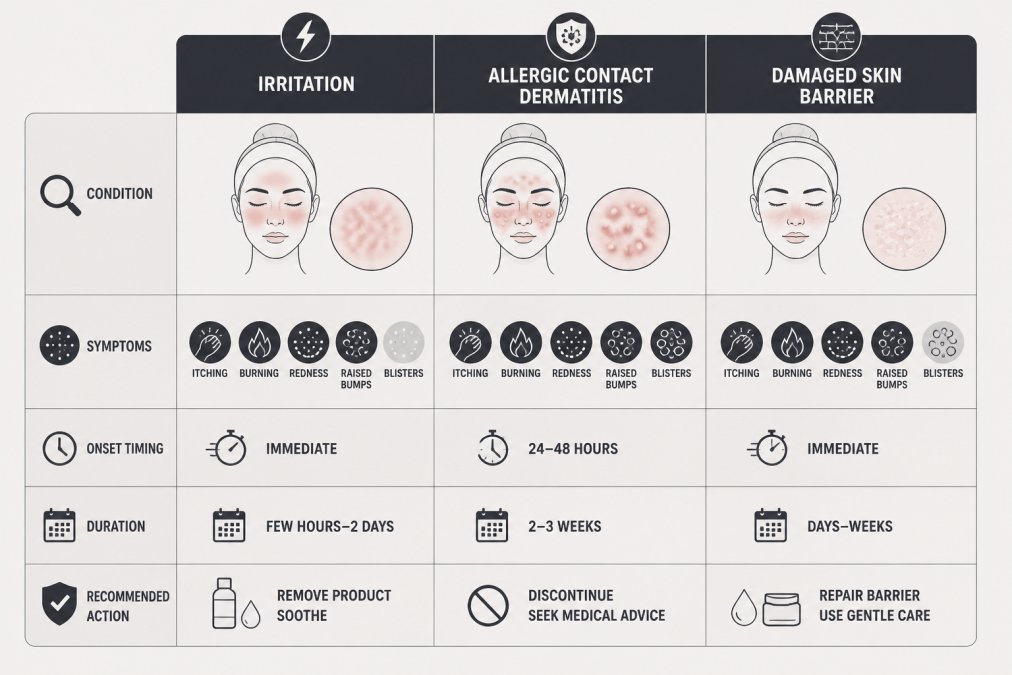
Immediate versus delayed reactions
Immediate reactions happen within minutes to a few hours. You apply a product and feel burning, stinging, or see redness. These are usually irritation, not allergy.
Delayed reactions appear 24 to 48 hours after application. You might not connect the reaction to the product because so much time has passed. These are often allergic contact dermatitis.
Some reactions take even longer. If you use a product daily for a week before noticing itching or bumps, you're likely dealing with an allergic response that built up over time.
How to Read Skincare Ingredient Labels and Spot Risky Names
The ingredient list on your skincare tells you exactly what's in the formula. Ingredients are listed in descending order by concentration. The first few ingredients make up most of the product.
Start by scanning for known irritants to identify hidden irritants that may trigger your skin. If you've reacted to fragrance before, look for "fragrance," "parfum," or "essential oils" near the top of the list.
Then check the middle and end of the list for preservatives and emulsifiers. Even though they're in smaller amounts, they can still cause reactions.
Hidden names for common allergens and irritants
Fragrance hides under many names. "Fragrance," "parfum," "essential oils," and "natural fragrance" all mean the product contains undisclosed scent compounds.
Botanical extracts often appear under their Latin names. Lavandula angustifolia is lavender. Rosa damascena is rose. Chamomilla recutita is chamomile.
Preservatives have confusing names. Methylisothiazolinone is listed as "MI" or "MIT." Phenoxyethanol appears as "phenoxyethanol." Parabens include methylparaben, propylparaben, and butylparaben, each listed separately.
Emulsifiers like polysorbate come in numbered versions: polysorbate 20, polysorbate 80. Cetyl alcohol and cetearyl alcohol are emulsifiers, not the irritating type of alcohol, but some sensitive skin still reacts.
Use a Skincare Ingredient Checker App to Assess Risk
Ingredient checker apps scan your product's label and flag potential irritants. You input the product name or upload a photo of the ingredient list.
Popular options include INCIDecoder, Think Dirty, and Yuka. These tools save time when you're comparing multiple products. They highlight ingredients by risk level and explain what each one does.
The limitation: apps can't predict your personal reaction. An ingredient flagged as "high risk" might not bother your skin. An ingredient marked "safe" might irritate you. Apps are starting points, not final answers.
Step-by-Step: How to Patch Test Skincare Products
Step 2: Apply a small amount. Use a dime-sized amount of the product. Massage it gently into the test area.
Step 3: Leave it on. Don't wash it off. Let it stay on your skin for 48 hours.
Step 4: Watch for changes. Check the area every few hours. Look for redness, itching, bumps, or burning. Even mild stinging counts.
Step 5: Wait the full 48 hours. Some reactions take time. Don't assume it's safe after 12 hours.
The 48-hour patch test protocol
The 48-hour window is standard because it catches most immediate and early delayed reactions. Allergic contact dermatitis often shows up within 24 to 48 hours of exposure (Advancing the understanding of allergic contact dermatitis). Two days gives your immune system time to respond if it's going to.
Don't assume a product is safe after 24 hours. Some reactions take the full 48 hours to develop. Patience here prevents a painful face reaction later.
Limitations of patch testing and when to stop
Patch testing isn't perfect. A negative patch test doesn't guarantee your face won't react. Facial skin is more sensitive than arm or ear skin. A product that passes the patch test might still irritate your face.
Stop patch testing immediately if you see a strong reaction. Raised bumps, blistering, or intense itching mean stop. Don't wait the full 48 hours.
If you're testing multiple products, test only one at a time. Space tests at least 48 hours apart. This way, if a reaction happens, you'll know which product caused it.
Isolate the Culprit: A Product-Tracking Method
When multiple products in your routine cause reactions, finding the culprit feels impossible. A tracking method helps you pinpoint exactly which ingredient or product is the problem.
The goal is to use one product at a time, note your skin's response, and build up your routine slowly. This takes patience but eliminates guesswork.
Building a reaction diary
Start a simple log. For each product you test, write down:
- Product name and brand
- First application date
- How much you used
- Where you applied it
- Your skin's response (redness, itching, burning, bumps, dryness)
- How long the reaction lasted
Include the time of day you applied it and what else you used that day. If you applied a new cleanser and a new moisturizer on the same day, you won't know which one caused a reaction.
Track for at least one week per product. Some reactions take days to show up. A week gives you enough data to see patterns.
Reintroduction strategy and what to avoid
Once you've identified a culprit, remove it from your routine. Wait at least one week for your skin to calm down.
Use the new product every other day for the first week. If no reaction appears, increase to daily use.
This slow approach prevents confusion. If a reaction happens, you'll know exactly which product caused it because you've only added one new thing.
Avoid switching multiple products at once. Avoid testing new actives while your barrier is damaged. Avoid introducing fragrance-heavy products if you know fragrance irritates you.
When to Seek Professional Help
Patch testing and tracking work for most people. But some reactions need professional evaluation. See a dermatologist if:
- Reactions are severe (blistering, significant swelling, spreading rash)
- Reactions don't improve after removing the product
- You're reacting to almost every product you try
- You suspect a specific allergen but can't confirm it with patch testing
A dermatologist can perform formal patch testing using standardized allergens. This identifies your specific triggers with medical precision. It's worth the appointment if your skin is severely reactive.
Finding the right skincare when your skin is sensitive takes detective work. The good news is that most hidden irritants can be identified with careful testing and tracking. Once you know what triggers your skin, you can choose products that work with your skin instead of against it. Regnal Radiance's Sensitive Skin Body Cream and Gentle Cleansing Milk are formulated specifically for sensitive skin with calming ingredients.

Frequently Asked Questions
What are the main symptoms of skincare allergy symptoms versus general irritation?
Irritation typically causes burning, stinging, or dryness and appears within minutes to hours. Allergic reactions develop over 24-48 hours and involve itching, raised bumps, or small blisters. Irritation usually improves once you stop using the product; allergic reactions persist longer. A damaged skin barrier causes tightness, dryness, and sensitivity to multiple products. Patch testing helps distinguish between them by isolating one product at a time.
How do I use a skincare ingredient checker app to identify hidden irritants?
Download a free ingredient checker app, enter the product name or scan the barcode, and the app displays each ingredient with hazard ratings. Look for red-flagged items like fragrance, essential oils, or known allergens. Cross-reference the ingredient list on your product label to confirm accuracy. Apps highlight hidden names for common irritants (for example, 'parfum' means fragrance). Use this data alongside your reaction diary to spot patterns across multiple products.
What is the correct way to patch test skincare products to avoid false results?
Apply a small amount of the new product to clean skin behind your ear or on your inner arm. Leave it undisturbed for 48 hours without washing or applying other products to that area. Check at 24 and 48 hours for redness, itching, bumps, or burning. Introduce only one new product at a time so you know which one caused any reaction. If no reaction appears after 48 hours, you can cautiously introduce it into your routine, but some delayed reactions take 5-7 days to emerge.
How do I read skincare ingredient labels to spot risky ingredients for sensitive skin?
Ingredients are listed in descending order by concentration; those at the top are most abundant. Watch for fragrance (listed as 'fragrance,' 'parfum,' or 'essential oils'), botanical extracts (plant-derived irritants), and actives like retinol or acids. Check for preservatives like parabens or formaldehyde releasers, and emulsifiers that can disrupt the skin barrier. Use an ingredient checker app to decode scientific names. If a product contains multiple potential irritants, it's harder to identify which one caused a reaction.