
Table of Contents
- Why Sensitive Skin Needs a Different Anti-Aging Approach
- Core Anti-Aging Ingredients That Work for Sensitive Skin
- Retinol Alternatives for Sensitive Skin
- How to Introduce Retinol to Sensitive Skin Safely
- Building Your Anti-Aging Routine for Sensitive Skin
- Sunscreen for Sensitive Skin: Your Most Important Anti-Aging Step
- Realistic Timelines and What to Expect
- Common Mistakes and How to Avoid Them
- Frequently Asked Questions
Last Updated: October 17, 2026
Why Sensitive Skin Needs a Different Anti-Aging Approach
Effective anti aging for sensitive skin requires a completely different strategy than standard anti-aging routines. Your skin's protective barrier is already compromised, making it prone to irritation, redness, and reactivity. At Regnal Radiance, we've built our approach around the principle that the gentlest formulas often deliver the most sustainable results for sensitive skin.

The core challenge is this: most anti-aging ingredients were developed for normal to oily skin types. Retinoids, vitamin C, and chemical exfoliants can trigger flare-ups in sensitive skin. This doesn't mean you can't address fine lines, age spots, or loss of firmness.
Your skin barrier does the real work. When it's healthy, it holds moisture, blocks irritants, and supports collagen production naturally. Damage the barrier with the wrong products, and you'll see more redness, dryness, and accelerated aging, not less. That's why hydration and protection matter as much as active ingredients for sensitive skin.
Core Anti-Aging Ingredients That Work for Sensitive Skin
Not all anti-aging ingredients trigger reactions. Some actually calm and protect while addressing visible signs of aging. The key is choosing actives designed for reactive skin and understanding how they work at a gentler intensity.
Peptides: Strength Without Irritation
Peptides are short chains of amino acids that signal your skin to produce more collagen and elasticity (Peptides: Emerging Candidates for the Prevention and Treatment of Skin Senescence: A...). Unlike retinoids, they don't cause peeling, redness, or sensitivity flare-ups. They work gradually, which makes them ideal for sensitive skin that can't tolerate aggressive actives.
Peptides improve skin firmness and reduce fine lines by supporting your skin's natural repair processes. They're also hydrating, which means they address dryness, a major concern for sensitive skin types.
The Regnal Radiance Anti-Aging Peptide Collection uses 2% Hexapeptide-11, a concentration designed to be effective without causing irritation. It pairs peptides with hyaluronic acid for multi-layer hydration and ginkgo biloba extract for antioxidant protection. This combination targets fine lines, firmness, and barrier support simultaneously.

Hyaluronic Acid and Hydration as Anti-Aging
Hyaluronic acid is one of the most underrated anti-aging ingredients for sensitive skin. It holds up to 1000 times its weight in water, plumping skin from within and smoothing fine lines temporarily while supporting long-term skin health.
When your skin is properly hydrated, it looks fuller and younger. Dehydrated skin shows wrinkles more prominently and becomes more reactive. Hyaluronic acid works at multiple molecular weights to hydrate skin at different depths, addressing both surface dryness and deeper dehydration.
Many people assume hydration is just about comfort. It's not. Hydrated skin produces more collagen, repairs faster, and resists irritation better. For sensitive skin, hydration is foundational anti-aging work.
Antioxidants and Environmental Protection
Antioxidants like ginkgo biloba extract, vitamin E, and rowanberry extract neutralize free radicals before they damage collagen and elastin. Environmental stressors, pollution, UV exposure, stress, accelerate aging. Antioxidants prevent this damage without triggering sensitivity.
Ginkgo biloba is particularly beneficial for sensitive skin. It protects against environmental stress and improves skin texture. Unlike vitamin C serums, which can irritate reactive skin, ginkgo works gently while still delivering visible anti-aging benefits.
The Antioxidant Ginkgo Gel Booster provides concentrated antioxidant protection. You can use it alone or mix it into your moisturizer for an extra layer of environmental defense. This flexibility makes it easy to adapt to your skin's daily tolerance.
:::pro-tip Layer antioxidants under your moisturizer, not over it. This protects the barrier while allowing the antioxidant to work without excessive penetration that might trigger irritation.
Retinol Alternatives for Sensitive Skin
Retinol is the gold standard for reducing wrinkles and age spots. The problem: it causes peeling, redness, and irritation in sensitive skin. For many people with reactive skin, retinol is simply not an option, at least not in standard formulations.
Retinol alternatives deliver similar anti-aging benefits with less irritation. Retinyl palmitate, bakuchiol, and peptides all address aging concerns without the harsh adjustment period retinol demands.
Bakuchiol is an alternative to retinol (pubmed.ncbi.nlm.nih.gov). It reduces fine lines and age spots, improves firmness, and supports skin renewal, all without peeling or irritation.
Peptides, as mentioned above, also function as a retinol alternative for sensitive skin. They're gentler, better tolerated, and support the barrier while addressing aging.
The reality: if your skin is truly sensitive, you might never tolerate prescription-strength retinoids. That's okay. Alternatives deliver meaningful anti-aging results without the risk of compromised barrier function or chronic irritation.
How to Introduce Retinol to Sensitive Skin Safely
If you want to try retinol despite sensitivity, the introduction protocol matters more than the product itself. Rushing causes damage. Patience builds tolerance.
The Patch Test and Irritation vs. Allergy
Before using any new active ingredient, patch test it on a small area of skin, the inner arm or behind the ear works well. Apply a pea-sized amount and wait 24-48 hours. If you see redness, swelling, or hives, you have an allergy. Stop immediately.
Temporary irritation looks different. Mild redness, slight dryness, or light flaking after retinol is normal adjustment. True allergy causes intense itching, swelling, or hives that don't resolve.
Most people confuse irritation with allergy. Irritation is your skin adapting. Allergy is your immune system rejecting the ingredient.
The Slow Introduction Protocol
Start with retinol once per week. Apply it to completely dry skin (wait 20 minutes after cleansing). Use a pea-sized amount. Follow with a heavy moisturizer to buffer irritation.
After one week, move to twice weekly if your skin tolerates it. Continue this pattern for 4 weeks. Then increase to three times weekly. This gradual approach lets your skin build tolerance without triggering a barrier breakdown.
If you experience intense redness, peeling, or dryness, drop back to the previous frequency. Skin tolerance builds slowly. Patience prevents damage.
Never combine retinol with other actives like vitamin C, acids, or peptides during the introduction phase. Let your skin adjust to one thing at a time.
Building Your Anti-Aging Routine for Sensitive Skin
A good routine is simple, consistent, and built around your skin's actual tolerance level. Most people overcomplicate this. You need a cleanser, hydration, protection, and one active ingredient. That's it.
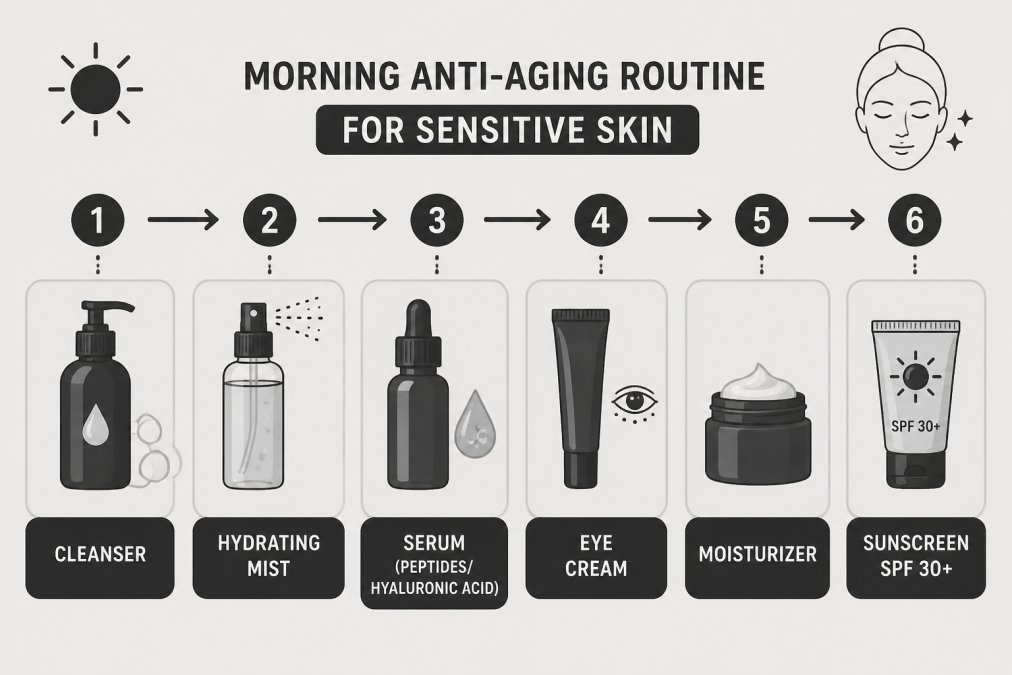
Morning Routine: Protection and Hydration
Step 1: Gentle Cleanser Use a fragrance-free, creamy cleanser that doesn't strip moisture. Avoid sulfates and physical scrubs.
Step 2: Hydrating Toner or Mist Apply a hydrating toner or the Microbiome Prebiotics Face Mist to damp skin. This preps your skin to absorb the next layers.
Step 3: Serum Apply a peptide serum or hyaluronic acid serum. This is your active anti-aging step in the morning.
Step 4: Eye Cream Dab a small amount of eye cream around the orbital bone using your ring finger. The delicate eye area needs dedicated support.
Anti-Aging Peptide Collection →
Step 5: Moisturizer Seal everything in with a hydrating day cream. The Moisturizing Day Cream uses multi-molecular hyaluronic acid to lock in moisture and provide all-day hydration.

Step 6: Sunscreen Apply broad-spectrum SPF 30 or higher. This is non-negotiable. Sun damage accelerates aging more than any other factor.
Evening Routine: Repair and Active Ingredients
Step 1: Gentle Cleanser Remove makeup and daily grime with the same fragrance-free cleanser. Double cleanse if you wore makeup, first with an oil cleanser, then with your regular cleanser.
Step 2: Hydrating Toner or Mist Apply the Microbiome Prebiotics Face Mist to damp skin.
Step 3: Active Serum This is where you apply your chosen active, peptides, bakuchiol, or retinol if you're introducing it. Start with 2-3 times weekly if using retinol. Use peptides nightly.
Step 4: Eye Cream Apply the same eye cream as morning routine. Overnight repair is crucial for the delicate eye area.
Step 5: Moisturizer Use a richer night cream if your skin is very dry. The Peptide Ageless AM/PM Cream works day and night.
Optional: Facial Oil If your skin is very dry, add a facial oil as the final step. This seals in all previous layers and provides overnight repair.
Sunscreen for Sensitive Skin: Your Most Important Anti-Aging Step
Sunscreen is the most effective anti-aging product you own. UV exposure causes 80% of visible skin aging. Wrinkles, age spots, uneven tone, and loss of firmness are largely photoaging, damage from cumulative sun exposure.
Using sunscreen daily prevents new damage.
For sensitive skin, physical sunscreens (zinc oxide or titanium dioxide) are often better tolerated than chemical sunscreens. Physical blockers sit on the skin surface and reflect UV rays. They don't absorb into skin or trigger irritation as easily.
Apply sunscreen generously, most people use too little. You need about a quarter-teaspoon for your face. Reapply every two hours if you're outdoors, or after swimming or sweating.
Many people skip sunscreen on cloudy days or indoors. UV rays penetrate clouds and windows. Daily sunscreen is non-negotiable for anti-aging and skin protection.
Realistic Timelines and What to Expect
Anti-aging results take time. Patience is essential. Here's what realistic timelines look like for sensitive skin:
Weeks 1-2: Skin feels hydrated. Redness may decrease slightly. Fine lines appear less prominent due to hydration plumping.
Weeks 3-4: Skin texture improves. Dryness resolves. Redness continues to decrease if you're using calming ingredients.
Weeks 6-8: Fine lines show visible improvement. Skin tone becomes more even. Age spots may lighten slightly.
Weeks 12+: Significant reduction in fine lines. Firmness improves noticeably. Age spots continue to fade. Skin texture is smoother and more radiant.
These timelines assume consistent use and proper sun protection. Skipping steps or inconsistent application delays results.
Some results are temporary (hydration plumping fine lines). Others are permanent (collagen production, barrier repair, age spot fading).
Common Mistakes and How to Avoid Them
Mistake 1: Layering Too Many Actives Using retinol, vitamin C, peptides, and acids all at once overwhelms sensitive skin.
Mistake 2: Skipping Moisturizer to "Let Skin Breathe" Dry skin is irritated skin. Hydration is not optional.
Mistake 3: Introducing Actives Too Fast Rushing the retinol introduction protocol causes barrier damage. Slow and steady builds tolerance. Fast causes setbacks.
Mistake 4: Forgetting Sunscreen This undoes all your anti-aging work. Without sunscreen, you're fighting photoaging while continuing to cause it.
Mistake 5: Changing Products Too Often Give each product 6-8 weeks before deciding if it works.
Mistake 6: Using Fragrance or Essential Oils Fragrance is irritating. Even "natural" essential oils can trigger sensitivity. Stick to fragrance-free formulas.
Building an effective anti aging for sensitive skin means prioritizing barrier health and choosing gentle actives that deliver real results without compromise.
Frequently Asked Questions
What is the most effective anti-aging ingredient for sensitive skin?
Peptides and hyaluronic acid are among the most effective and gentle anti-aging ingredients for sensitive skin. Peptides like hexapeptide-11 work to firm and smooth fine lines, while hyaluronic acid hydrates deeply at multiple skin depths, plumping the skin to reduce the appearance of wrinkles. Antioxidants such as ginkgo biloba protect against environmental damage that accelerates aging. Unlike retinoids, these ingredients rarely cause irritation, making them ideal for building an effective anti-aging routine for sensitive skin.
Can sensitive skin use retinol, and what are safer alternatives?
Sensitive skin can use retinol, but it requires careful introduction and often benefits from gentler retinol alternatives first. Bakuchiol, peptides, and time-release retinol formulations offer anti-aging benefits with lower irritation risk. Start with retinol alternatives for sensitive skin at low concentrations, patch test first, and introduce gradually over weeks. If irritation persists, stick with peptides and antioxidants, which deliver visible anti-aging results without the adjustment period retinol demands.
How long does it take to see anti-aging results on sensitive skin?
Results depend on ingredient strength, skin barrier health, and how well you tolerate actives. Hydration-focused ingredients like hyaluronic acid show faster results, while peptides and antioxidants build benefits over time. Patience and consistency matter more than strength when managing sensitive skin.
Should I patch test anti-aging skincare products before full use?
Yes, patch testing is essential for sensitive skin, especially when introducing new actives. Apply a small amount behind your ear or on your inner arm for 24-48 hours before using on your face. This reveals true allergies versus temporary irritation. If you experience redness, itching, or swelling that doesn't fade within a few hours, the product may not suit you.