
Last Updated: November 7, 2026
Quick Summary
Choose a fragrance-free, mineral-based sunscreen stick rated SPF 30 or higher that is non-comedogenic, since zinc oxide and titanium dioxide are least likely to irritate reactive skin. Patch-test any new stick on your inner wrist or jawline for 24 to 48 hours before applying it to your full face.
- Screen labels for fragrance, drying alcohols and oxybenzone, and avoid avobenzone and octinoxate if chemical filters have irritated you.
- Mineral sticks can feel thicker and leave a white cast on deeper skin tones, so swatch before committing.
- Apply several passes over the face, since the SPF rating assumes about a quarter teaspoon for the face alone.
- Reapply every two hours outdoors, and once in the morning indoors near windows.
- Wipe the stick surface with a tissue after each use and never share a stick on broken skin.
Table of Contents
- Why a Daily Sunscreen Stick Works for Sensitive Skin
- Best Sunscreen Stick for Sensitive Skin: What to Look For
- Best Sunscreen Stick for Face: Texture, Finish and Makeup Compatibility
- Best Daily Sunscreen Stick for Sensitive Skin Drugstore Options
- Best Sunscreen Stick Dermatologist Recommended: How to Judge the Claims
- Application Amount and Real-World Protection
- Choosing Your Sensitive Skin Sunscreen Stick
- Frequently Asked Questions
Why a Daily Sunscreen Stick Works for Sensitive Skin
Sunscreen sticks earn their place in a sensitive-skin routine because they cut out two common triggers: messy liquid formulas that sting on application and preservative-heavy creams that sit on reactive skin all day. People with reactive skin often want sun protection they will actually reapply, not a bottle they dread touching.
Daily UV exposure is the main driver of premature lines, uneven tone and post-blemish marks. The Skin Cancer Foundation's sun protection guidance is blunt about it: daily, broad-spectrum SPF use is the single most effective anti-aging habit available. A stick makes that habit realistic. Swipe, blend, move on.
The catch is that not every stick suits sensitive skin. Thick wax-based formulas can clog pores and trigger breakouts, as Clinikally's analysis of sunscreen sticks cautions. Below, we show you exactly how to screen a formula, apply enough of it, and build a daily habit that holds up.
If your skin is currently reactive, our guide on how to soothe reactive skin pairs well with daily SPF use.
Best Sunscreen Stick for Sensitive Skin: What to Look For
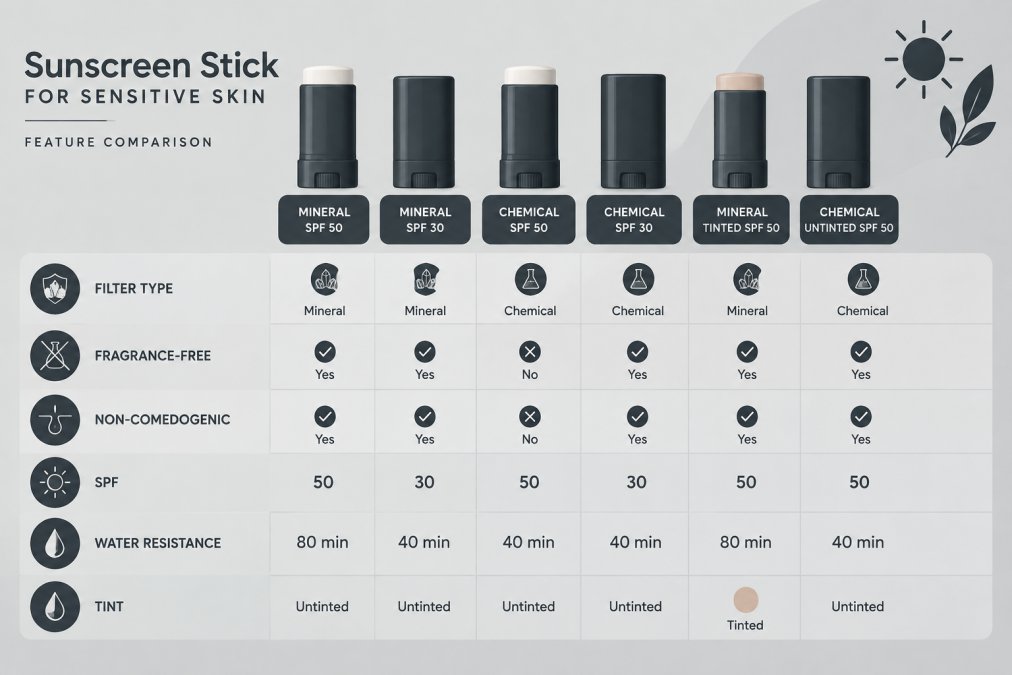
A sunscreen stick suited to sensitive skin is typically fragrance-free, mineral-based, non-comedogenic and rated SPF 30 or higher. But sensitive skin is not one-size-fits-all: a formula that works for one person can trigger a reaction in another. The goal is to minimize known irritants and then patch-test anything new.
Start with the label, not the marketing. "Clean" and "gentle" are unregulated words. "Fragrance-free," "non-comedogenic" and a visible zinc oxide or titanium dioxide listing are meaningful. Also look for a short ingredient list, fewer ingredients means fewer chances for a reaction.
Ingredient Screening for Reactive Skin
Screen for three things: fragrance, drying alcohols and known sensitizers like oxybenzone. Fragrance is the most common cause of contact reactions in cosmetics, and it hides under dozens of names, including "parfum," "essential oil blend," and individual components like limonene or linalool. Drying alcohols (denatured alcohol, SD alcohol) can strip the skin barrier and worsen reactivity. Oxybenzone is a chemical UV filter that some people with sensitive skin find irritating; mineral filters avoid it entirely.
A practical checklist for your next label read:
- Fragrance-free: Look for "fragrance-free" or "no added fragrance", not just "unscented," which may contain masking fragrance.
- Mineral filters only: Zinc oxide and titanium dioxide are the least likely to cause irritation. Avoid avobenzone, octinoxate, and oxybenzone if you have reacted to chemical sunscreens before.
- No drying alcohols: Denatured alcohol, SD alcohol, and isopropyl alcohol can be drying and irritating.
- Soothing ingredients: Niacinamide, glycerin, ceramides, and aloe can help support the skin barrier, though they are not guarantees against irritation.
- Non-comedogenic: Especially important if you are prone to breakouts or clogged pores.
Our ingredients to avoid for sensitive skin guide lists the full set. For label-reading technique, see how to identify hidden irritants in skincare.
Watch out: "Hypoallergenic" and "dermatologist tested" are not regulated guarantees, they indicate lower risk, not zero risk. Always patch-test a new stick on your inner wrist or jawline for 24-48 hours before applying it to your full face.
Mineral vs Chemical Filters: What the Evidence Shows
Mineral filters, zinc oxide and titanium dioxide, sit on the skin surface and deflect UV rays. Chemical filters absorb UV and convert it to heat. For reactive skin, mineral filters are often chosen because they sit on the surface of the skin. However, the evidence is not absolute: some people tolerate chemical filters well, and mineral formulas can still contain irritating inactive ingredients.
The trade-off is texture. Mineral sticks can feel thicker and leave a white cast on deeper skin tones, so swatch before committing. Chemical sticks often feel lighter and invisible, but may sting if they migrate into the eyes. If you have reacted to chemical sunscreens in the past, start with mineral; if you have not, either type can work as long as the inactive ingredients are gentle.
Individual tolerance varies, so introducing one new product at a time and monitoring for stinging, redness or breakouts is a sensible approach. The best approach is to introduce one new product at a time and monitor for stinging, redness, or breakouts.
Best Sunscreen Stick for Face: Texture, Finish and Makeup Compatibility
A face sunscreen stick should glide without dragging, dry down within a minute, and layer under makeup without pilling. Test it on your jawline first, not your whole face.
Tinted sticks can reduce the look of a white cast and offer light coverage. Untinted sticks suit anyone layering foundation on top. Either way, apply the stick first, let it set, then apply makeup.
For a deeper look at tint, finish and layering, read our guide on choosing a clean beauty SPF 50 tinted sunscreen stick.
Watch out: applying makeup immediately over a wet stick formula causes pilling and patchy coverage. Give it 60 seconds.
Best Daily Sunscreen Stick for Sensitive Skin Drugstore Options
Drugstore sunscreen sticks are a sensible starting point because the format is standardized and the price of testing a formula is low. Look for a short ingredient list, a mineral filter and an explicit fragrance-free claim.
Two practical checks before you buy:
- Swatch on your inner wrist and wait 24 hours
- Confirm the stick is wide enough for comfortable facial coverage
Best Sunscreen Stick Dermatologist Recommended: How to Judge the Claims
A "dermatologist recommended" badge can reflect an endorsement or a survey, and it is not a guarantee your skin will tolerate the formula.
Judge claims by what is verifiable: a broad-spectrum label, a specific SPF number, a full ingredient list and a stated reapplication interval. Anything vaguer is marketing.
| Claim | What It Actually Means | How to Verify |
|---|---|---|
| Dermatologist recommended | Paid endorsement or survey | Check for a named body |
| Broad-spectrum | Covers UVA and UVB | Look for the label claim |
| Non-comedogenic | Formulated to reduce pore clogging | Ingredient list review |
| Hypoallergenic | Lower reaction risk, not zero | Patch test anyway |
| Water resistant | Holds through sweat or swimming | Stated duration on pack |
Application Amount and Real-World Protection
Most people apply far less sunscreen than the SPF number assumes, which means real-world protection is lower than the label suggests. A stick makes under-application easy to miss: a few quick swipes may feel like enough, but the SPF rating is based on applying 2 mg of product per square centimeter of skin, roughly a quarter teaspoon for the face alone. With a stick, that translates to multiple passes over each area, not a single glide.
A practical approach for a stick is to make several passes over the face until the area is evenly covered, and to reapply every two hours outdoors. Indoors near windows, once in the morning is a reasonable baseline. For the body, use a continuous layer and rub it in if the stick allows, sticks are convenient for reapplication, but they are not always the most efficient way to apply the initial dose.
Watch out: Stick formulas vary in how much product they deposit per swipe. A hard, waxy stick may deliver less than a soft, creamy one. If you can see a visible film, you have likely applied enough; if the skin looks bare, add another pass.
Hygiene and Use Over Makeup
Wipe the stick surface with a tissue after each use, and never share a stick on broken skin. Over makeup, dab and blend with a fingertip rather than dragging the stick across foundation, dragging can disturb the makeup and leave the sunscreen uneven. For daily use, consider a separate stick for face and body to avoid transferring bacteria from the body to the face.
A common mistake is applying a stick over makeup and assuming full coverage. In practice, the stick may not adhere evenly over powder or silicone-based foundations, leaving gaps. If you wear makeup daily, apply the stick first, let it set for 60 seconds, then apply makeup on top. For touch-ups, use a tinted stick or a light dab with a fingertip and blend outward.
Patch-testing and stopping use: if you notice stinging, redness, or itching after application, stop using the product and consult a dermatologist if symptoms persist. Sensitivity can develop over time, so a product that worked for months may suddenly cause a reaction, pay attention to changes in your skin.
Choosing Your Sensitive Skin Sunscreen Stick
Choose a fragrance-free mineral stick at SPF 50 if your skin reacts easily, and prioritize glide and finish if you wear makeup daily.
Our SPF50 tinted sunscreen stick is mineral-based and gentle enough for sensitive areas around the eyes and nose. Swipe, blend, and you're covered.

Reactive skin rarely fails because of one product. It fails because the routine has too many variables and no consistency. Sun protection is the one step worth getting right every single day, and a stick removes the friction that makes people skip it. Regnal Radiance builds intentional formulas for this kind of routine: designed to restore and protect your natural glow and gentle enough for sensitive skin. If you want sun care that fits a calm, simple morning ritual, get started with Regnal Radiance and give your skin daily protection it can tolerate.
Frequently Asked Questions
Are sunscreen sticks actually effective for daily use?
Yes, but only when applied generously. A sunscreen stick delivers broad-spectrum SPF 50 protection if you swipe enough layers to reach the recommended amount, roughly two milligrams per square centimeter. Most people under-apply sticks because the thin glide feels sufficient. For daily use on sensitive skin, apply two to three passes over each area, then blend with clean fingers. Reapply every two hours outdoors, and after swimming, sweating or towel drying. A stick is convenient for touch-ups, but pairing it with a lotion base gives more reliable coverage.
What sunscreen do dermatologists recommend for sensitive skin?
Mineral-based sunscreen sticks are one option for sensitive skin, since zinc oxide and titanium dioxide sit on the skin surface. Look for fragrance-free, hypoallergenic and non-comedogenic labels. A patch test behind the ear for two days helps confirm tolerance before daily use. SPF 50 broad-spectrum protection with UVA and UVB coverage is the practical target. Regnal Radiance's SPF50 Tinted Sunscreen Stick is mineral-based and dermatologically tested.
Can you use a sunscreen stick on your face every day?
A daily sunscreen stick suits the face when the formula is non-comedogenic and fragrance-free. Apply it as the last step of your morning skincare routine, before makeup. The stick format can be used around the eyes and nose. One caveat: thick stick formulas can clog pores or trigger breakouts in blemish-prone skin, so patch test first. Reapply every two hours if you are outdoors, and use a tinted stick to refresh protection over makeup without disturbing the base.
Can sunscreen sticks be used over makeup?
Yes, and this is one of the format's main advantages. A tinted or translucent stick glides over foundation without smudging it, making midday reapplication realistic. Swipe gently rather than dragging, and blend the edges with a fingertip. Hygiene matters: wipe the stick surface with a tissue after each use on a made-up face to remove product buildup. Avoid sharing sticks, and replace them if the texture changes or develops an odor. For sensitive skin, choose a fragrance-free stick to minimize irritation during touch-ups.
