
Table of Contents
- What Reactive and Sensitive Skin Actually Means
- Step 1: Identify What's Triggering Your Skin Flare-Up
- Step 2: Pause Products and Simplify Your Skincare Routine for Sensitive Skin Flare-Ups
- Step 3: Ingredients to Avoid for Sensitive Skin
- Step 4: Cleanse Gently and Support Your Skin Barrier
- Step 5: How to Reduce Redness on Face and Soothe Irritation
- How Long Does It Take for Irritated Skin to Calm Down
- When to Seek Professional Help
- Frequently Asked Questions
Last Updated: October 18, 2026
What Reactive and Sensitive Skin Actually Means
Reactive skin is skin that responds quickly and intensely to irritants, environmental triggers, or product ingredients. It's different from sensitive skin, though the terms often overlap. Sensitive skin is a skin type you're born with.

When your skin is reactive, it shows visible signs fast. You might see redness, itching, burning, tightness, or dryness within minutes of applying a product or being exposed to a trigger. The skin barrier is your skin's protective layer.
The good news: reactive skin is manageable. You just need the right approach.
Step 1: Identify What's Triggering Your Skin Flare-Up
The first step to soothe reactive skin is finding out what's causing the reaction. Without knowing your trigger, you'll keep repeating the same cycle.
Start with a trigger diary. For two weeks, record the following each day:
- Products used (cleanser, moisturizer, sunscreen, makeup, and any actives), including the full ingredient list if you can
- Environmental exposures: weather (heat, cold, wind, humidity), sun exposure, pollution, chlorine, or sudden temperature changes
- Lifestyle factors: stress levels, sleep quality, alcohol intake, and hormonal changes (e.g., menstrual cycle phase)
- Timing of symptoms: when redness, itching, or burning started and how long it lasted
A simple notes app or paper journal works. The goal is to spot patterns, not to be perfect.
Common triggers to watch for:
- Product ingredients: fragrances, essential oils, drying alcohols, exfoliating acids (glycolic, salicylic, lactic), retinoids, vitamin C (especially L-ascorbic acid), benzoyl peroxide, and sulfates
- Environmental factors: harsh weather, pollution, chlorine, and sudden temperature changes
- Skincare routine mistakes: over-exfoliating, using hot water, or layering too many active ingredients at once
- Lifestyle factors: stress, poor sleep, dehydration, and hormonal fluctuations
- Allergens: pollen, pet dander, dust mites, and certain preservatives or metals (e.g., nickel in jewelry or cosmetics)
Reactive skin vs. allergy vs. rosacea vs. eczema
Reactive skin is a temporary state where the skin barrier is compromised and responds to irritants it normally tolerates. Eczema (atopic dermatitis) is a chronic inflammatory condition with dry, itchy, and inflamed patches (Atopic Dermatitis: A Review of Diagnosis and Treatment).
If your skin reacts even to gentle products, or if symptoms persist beyond a few weeks, it's worth seeing a dermatologist to rule out these conditions.
When to seek urgent care
Most reactive skin flare-ups are mild and manageable at home. However, seek prompt medical attention if you experience:
- Swelling of the face, lips, tongue, or throat
- Difficulty breathing or swallowing
- Blistering, oozing, or severe pain
- A fever or feeling unwell
- A rash that spreads rapidly
These could indicate a severe allergic reaction or infection, which require immediate care.
Step 2: Pause Products and Simplify Your Skincare Routine for Sensitive Skin Flare-Ups
When your skin is flaring up, your first instinct might be to add more products to fix it. Don't.
A simplified routine for reactive skin includes only:
- A gentle cleanser
- A hydrating moisturizer
- Sunscreen during the day (if you go outside)
That's it. Remove everything else temporarily:
- Stop using active ingredients (vitamin C, retinoids, acids, peptides)
- Stop using toners, essences, or serums
- Stop using exfoliants or physical scrubs
- Stop using masks or intensive treatments
This pause lasts until your skin calms down. For mild flare-ups, that's 3-5 days. For severe ones, it might be 1-2 weeks.
Why? Your skin barrier is already compromised. Adding more products, even "soothing" ones, can overwhelm it further. Simplicity lets your skin focus on healing.
Once the acute flare-up subsides, reintroduce products one at a time, waiting 3-5 days between additions.
Step 3: Ingredients to Avoid for Sensitive Skin
Certain ingredients trigger reactive skin more often than others. If your skin is flaring up, avoid these:
Common irritants:
- Fragrance (synthetic or natural essential oils)
- Alcohol denat (drying alcohol)
- Menthol or camphor (cooling agents that irritate)
- High-concentration acids (glycolic, salicylic, lactic)
- Retinoids and retinol
- Vitamin C (L-ascorbic acid)
- Benzoyl peroxide
- Sulfates (harsh cleansing agents)
Ingredients that may irritate sensitive skin:
- Citrus extracts or citric acid
- Witch hazel with high alcohol content
- Tea tree oil
- Eucalyptus oil
- Some preservatives (parabens, formaldehyde releasers)
Not everyone reacts to all of these. Your specific triggers depend on your skin type and barrier condition.
How to assess ingredient labels
Ingredient lists are ordered by concentration, with the highest amounts first.
Patch testing: a repeatable method
Before using a new product on your face, patch test it on a small area of skin. Here's a reliable method:
- Apply a small amount of the product to the inner forearm or behind the ear.
- Leave it on for 24 hours without washing it off.
- Check for redness, itching, or swelling. If no reaction, repeat on the same spot for another 24-48 hours.
- If no reaction after 48-72 hours, the product is unlikely to cause irritation on your face, but introduce it slowly.
Safe product reintroduction after a flare-up
Once your skin has calmed down (typically 1-2 weeks of a simplified routine), reintroduce products one at a time. Wait 3-5 days between adding each new product.
Ingredient nuances
- Fragrance: Avoid all fragrances, including essential oils, during a flare-up. Even "natural" fragrances like lavender or citrus can irritate.
- Exfoliating acids: Avoid completely during a flare-up. After recovery, introduce one acid at a low concentration (e.g., 5% lactic acid) once or twice a week.
- Retinoids: These can be irritating even for non-reactive skin. If you use them, start with a low-strength formula (e.g., 0.1% retinol) and apply every third night.
- Vitamin C: L-ascorbic acid can sting reactive skin. Consider gentler derivatives like sodium ascorbyl phosphate or magnesium ascorbyl phosphate.
When choosing products for reactive skin, look for labels that say:
- Fragrance-free
- Hypoallergenic
- Dermatologist-tested
- Free of common irritants
Read ingredient lists carefully. "Unscented" is not the same as "fragrance-free", unscented products can still contain fragrance that masks odor.
Step 4: Cleanse Gently and Support Your Skin Barrier
How you cleanse matters as much as what you use. Harsh cleansing damages your skin barrier further, prolonging the flare-up.
Gentle cleansing do's:
- Use lukewarm water, not hot
- Apply cleanser with your fingertips, not a washcloth or brush
- Massage gently for 30-60 seconds
- Rinse thoroughly with lukewarm water
- Pat dry gently, don't rub
Gentle cleansing don'ts:
- Don't use hot water (it strips natural oils)
- Don't scrub or use physical exfoliants
- Don't use harsh soaps
- Don't over-cleanse (twice daily is enough; once daily is fine too)
Choose a gentle cleanser specifically formulated for sensitive or reactive skin. The Regnal Radiance Gentle Cleansing Milk removes makeup and impurities without stripping your skin. It contains shea butter and argan oil, which support your skin barrier while you cleanse.
After cleansing, apply moisturizer while your skin is still slightly damp. This locks in hydration and reinforces your barrier.
Step 5: How to Reduce Redness on Face and Soothe Irritation
Redness is inflammation. To reduce it, you need to calm the inflammation and support your skin barrier's recovery.
Immediate steps to reduce redness:
- Apply a hydrating moisturizer to damp skin
- Use a face mist for quick hydration throughout the day
- Avoid touching your face (bacteria and friction worsen inflammation)
- Keep your environment cool and humid
- Drink plenty of water
Ingredients that soothe reactive skin:

- Hyaluronic acid, holds moisture in your skin
- Glycerin, draws water into your skin
- Aloe vera, calms inflammation
- Ceramides, repair your skin barrier (pubmed.ncbi.nlm.nih.gov)
- Niacinamide, reduces redness and supports barrier function (Mechanistic Insights into the Multiple Functions of Niacinamide)
- Prebiotics, support your skin's natural microbiome
The Regnal Radiance Microbiome Prebiotics Face Mist delivers instant hydration and helps restore your skin barrier. Prebiotics support your skin's natural microbiome, which is essential for barrier health. Spray it on throughout the day whenever your skin feels tight or uncomfortable.
For deeper support, the Bioactive Prebiotics Jelly Serum strengthens your barrier and soothes redness. Its lightweight texture absorbs quickly without heaviness, making it ideal for reactive skin.

How Long Does It Take for Irritated Skin to Calm Down
Recovery time depends on how severe the flare-up is and how quickly you remove the trigger.
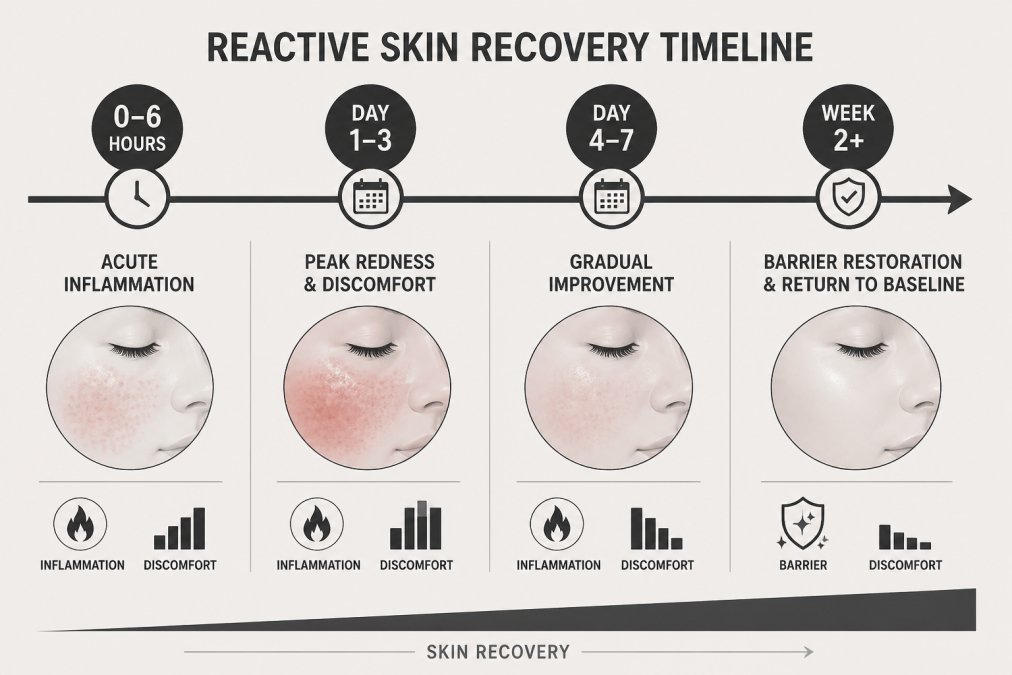
Mild flare-ups (slight redness, minor itching):
- Peak redness: 24-48 hours
- Visible improvement: 3-5 days
- Full recovery: 1-2 weeks
Moderate flare-ups (noticeable redness, itching, slight swelling):
- Peak redness: 2-3 days
- Visible improvement: 5-7 days
- Full recovery: 2-3 weeks
Severe flare-ups (intense redness, swelling, burning, blistering):
- Peak redness: 3-5 days
- Visible improvement: 1-2 weeks
- Full recovery: 3-4 weeks or longer
The timeline assumes you've identified and removed the trigger. If you keep using the irritating product, your skin won't improve.
During recovery, your skin barrier is still compromised. Keep your routine minimal and avoid new products. Patience is essential, pushing too hard or reintroducing irritants restarts the cycle.
When to Seek Professional Help
Some flare-ups need medical attention. See a dermatologist if:
- Your skin doesn't improve after 2-3 weeks of removing the trigger
- You develop blistering, oozing, or severe swelling
- Your skin feels hot or you have a fever
- You can't identify the trigger despite careful tracking
- The flare-up is spreading to other areas of your body
- You suspect an allergic reaction
- Your skin reacts to multiple gentle products (this suggests an underlying condition)
A dermatologist can:
- Rule out allergies, rosacea, eczema, or contact dermatitis
- Perform patch testing to identify specific allergens
- Prescribe topical treatments if needed
- Recommend a safe product reintroduction plan
Don't assume you have "sensitive skin" permanently. Many reactive flare-ups are temporary responses to specific triggers. Once your barrier heals and you identify what caused the reaction, your skin often returns to normal.
Reactive skin responds best to a calm, consistent approach. Remove the trigger, simplify your routine, and support your barrier with hydration. Most flare-ups improve within 1-3 weeks with this strategy.
If your skin is struggling with reactivity, Regnal Radiance's gentle formulas are designed for exactly this situation. Our Sensitive Skin Body Cream soothes redness and restores your skin's natural balance with calming, hydrating ingredients. Paired with our Gentle Cleansing Milk and prebiotics-based serums, you have a complete routine that supports barrier repair without irritation.
Frequently Asked Questions
What's the difference between reactive skin, sensitive skin, and a skin allergy?
Reactive skin flares up suddenly in response to specific triggers like harsh products or environmental stressors, while sensitive skin is chronically prone to irritation. Allergic reactions involve the immune system and typically cause swelling, hives, or severe itching. Reactive skin can develop redness and itching within hours of exposure, whereas sensitive skin reacts more easily to everyday irritants. If you suspect an allergy, see a dermatologist for testing rather than treating it at home.
How do I know which product is causing my skin flare-up?
Track what you used in the 24-48 hours before the flare-up started. If you introduced multiple new products, pause all of them and return to your most basic routine. Reintroduce one product at a time, waiting 3-5 days between each addition. Common culprits include new cleansers, active ingredients like acids or retinoids, fragrances, and products with essential oils. Keep a simple log of what you use and any reactions to identify patterns.
Can I use regular moisturizer on reactive skin, or do I need something special?
Regular moisturizers often contain fragrances, alcohols, or active ingredients that trigger reactive skin. Look for fragrance-free formulas with calming ingredients like aloe and shea butter. The Sensitive Skin Body Cream is designed specifically for irritated skin and locks in hydration without causing redness. Apply it to clean, damp skin to seal in moisture and support your skin barrier during a flare-up.
When should I see a dermatologist about reactive skin?
Seek professional guidance if your skin flare-up doesn't improve within 2 weeks, spreads beyond the initial area, develops blistering or severe swelling, or is accompanied by fever or oozing. A dermatologist can rule out rosacea, eczema, contact dermatitis, or infection, and recommend prescription treatments if needed. Don't wait if you suspect an allergic reaction or if home care isn't working.