
Last Updated: October 24, 2026
Quick Summary
The best body cream for extremely dry skin is a thicker, oil-rich formula that seals a damaged moisture barrier, while a lotion is a lighter water-based product for everyday upkeep. Creams use more emollients and occlusives, so they stay on the surface longer, and cream is the practical middle ground where most people with very dry skin should start.
- Lotions hydrate and creams protect, so choose a cream for extremely dry skin.
- Look for shea butter, jojoba oil, dimethicone or petrolatum in the top half of the ingredient list.
- Ceramides, cholesterol and fatty acids are the structural lipids skin uses to repair itself.
- Apply cream twice a day and always within three minutes of stepping out of the shower.
- See a doctor when dryness comes with bleeding cracks, spreading rash or itching that disrupts sleep.
Table of Contents
- What Separates a Body Cream From a Lotion
- The Best Body Lotion for Dry Skin Still Needs Barrier Ingredients
- Why a Moisturizer for Dry Skin With Ceramides Works Differently
- Body Oil vs. Lotion for Dry Skin: Which One Locks In Moisture
- How Often to Apply Body Lotion (and When to Apply More)
- Mistakes That Keep Extremely Dry Skin Dry
- When Dryness Needs a Doctor, Not Another Cream
- Choosing Your Body Cream at Regnal Radiance
- Frequently Asked Questions
What Separates a Body Cream From a Lotion
The best body cream for extremely dry skin is a thicker, oil-rich formula built to seal a damaged moisture barrier, while a lotion is a lighter water-based product for everyday upkeep.
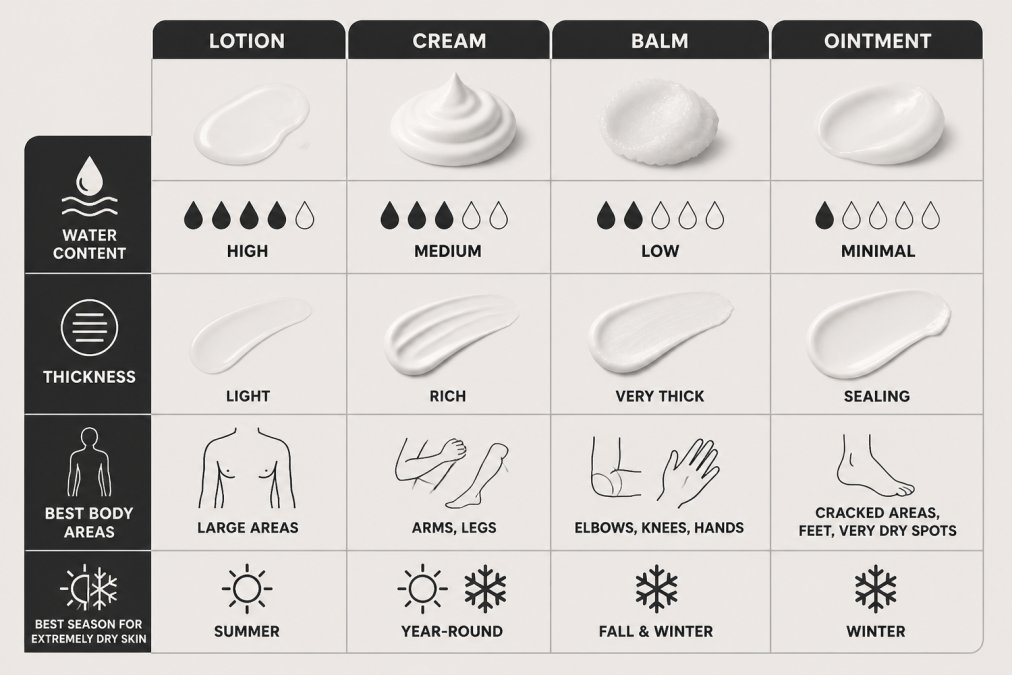
The texture gap comes down to water-to-oil ratio. Lotions carry more water, spread fast, and absorb within seconds. Creams flip the balance, using more emollients and occlusives so the formula stays on the surface longer.
Lotion, cream, balm and ointment: how to choose
Match the format to how dry your skin actually is, not to habit. The table below is a starting point, but the notes underneath explain the trade-offs most product pages skip.
| Format | Water Content | Thickness | Best Body Areas | Best Season | Typical Feel After 10 Minutes |
|---|---|---|---|---|---|
| Lotion | High | Light | Arms, chest, back | Summer | Absorbed, slightly cool |
| Cream | Medium | Rich | Legs, hands, full body | Autumn, winter | Soft, faintly tacky |
| Balm | Low | Very thick | Elbows, heels, cuticles | Deep winter | Protective film |
| Ointment | Minimal | Sealing | Cracked heels, split knuckles | Any flare-up | Glossy, occlusive |
A common mistake is buying the richest formula for the whole body. If you prefer plant-derived formulas, our guide to the best natural moisturizer for dry skin covers how to read those labels.
How to read a label before you buy
Front labels sell a feeling; the ingredient list tells you what the product will actually do. A few practical checks:
- First five ingredients: If water, glycerin, and a lightweight alcohol appear before any butter, oil, or fatty alcohol, the formula is built for normal-to-dry skin, not extremely dry skin.
- Emollient and occlusive presence: Look for shea butter, mango butter, jojoba oil, dimethicone, or petrolatum in the top half of the list. Their position signals how protective the cream will feel.
- Barrier ingredients: Ceramides, cholesterol, and fatty acids are the structural lipids skin uses to repair itself (pubmed.ncbi.nlm.nih.gov). Their presence usually justifies a higher price than a humectant-only lotion.
- Fragrance placement: Fragrance appears near the end of most lists even when it is the cause of irritation. For reactive skin, choose "fragrance-free" rather than "unscented," which can still contain masking fragrance.
Climate, body area, and value
Format choice is not only about dryness level. Cold, windy winters and low-humidity indoor heating push most people from lotion to cream, while humid summers make even very dry skin tolerate a lighter formula.
Value is not the same as shelf price. A rich cream used twice a day may last six to eight weeks, while a thin lotion that needs reapplying every few hours can cost more per month.
The Best Body Lotion for Dry Skin Still Needs Barrier Ingredients
A body lotion only earns its place if it repairs the skin barrier, not just wets the surface. The best body lotion for dry skin pairs humectants that pull water in with emollients and occlusives that hold it there.
Here is the split that matters:
- Humectants such as glycerin and hyaluronic acid draw water into the upper layers
- Emollients such as shea butter, mango butter and jojoba oil soften rough texture and fill the gaps between skin cells
- Occlusives form a breathable seal that slows water loss through the day
Many drugstore moisturizers lean hard on humectants because they are cheap and feel light. That is why a lightweight formula can leave very dry skin feeling tight an hour later.
Why a Moisturizer for Dry Skin With Ceramides Works Differently
A moisturizer for dry skin with ceramides works differently because ceramides are structural, not just hydrating. They are lipids that already exist between skin cells, and dry, flaky skin typically has fewer of them.
Think of the barrier as mortar between bricks. Humectants add moisture to the bricks; ceramides repair the mortar. For a deeper walkthrough of how these lipids behave over time, our complete guide to deep hydration for dry skin breaks down the repair process.
Urea, panthenol and hyaluronic acid: what each one does
These three actives show up in most serious dry-skin formulas, and each does a different job.
- Urea draws water into the skin and, at higher concentrations, softens thickened, rough patches on elbows, knees and heels
- Panthenol, or vitamin B5, calms tightness and supports the skin's own recovery
- Hyaluronic acid attracts and holds water, giving an immediate plumped feel
Concentration changes the outcome. A low percentage of urea hydrates gently; a higher percentage exfoliates and smooths. That is the trade-off most product pages never explain. If your skin stings easily, start with a lower-urea formula and build up.
Body Oil vs. Lotion for Dry Skin: Which One Locks In Moisture
Body oil locks in moisture better than lotion, but only when it goes on top of water.
So the honest answer to body oil vs. lotion for dry skin is that they solve different problems. Lotion or cream delivers water and barrier ingredients. Oil seals.
Watch out: applying oil before your cream can block the cream from absorbing, leaving both products working at half strength. Order matters more than price.
5% Urea + 2% Panthenol Body Cream →
How Often to Apply Body Lotion (and When to Apply More)
Apply body lotion or cream twice a day, and always within three minutes of stepping out of the shower while skin is still damp. That window is when the barrier absorbs the most water, and it is the single habit that separates people who stay comfortable from people who keep reapplying.
The damp-skin rule is not folklore. After bathing, the outer layer of skin holds extra water that will evaporate unless something slows it down.
How much to apply
Most people use too little. A useful rule of thumb is a generous layer, enough that the skin looks slightly shiny before it absorbs, rather than a thin film rubbed in until it disappears. For a full-body application, that often means an amount roughly the size of a large coin per limb, adjusted for how dry the area is. Hands, feet, elbows, and knees usually need a second pass.
- Full body after showering: a generous layer across arms, legs, and torso
- Targeted areas: an extra dab on heels, knuckles, and elbows
- Daytime top-up: a smaller amount on hands and any area that feels tight
Build the routine around your bath, not the clock
The most reliable routine is anchored to bathing rather than to a time of day. A common pattern is:
- Shower or bathe with lukewarm water and a gentle, fragrance-free cleanser.
- Pat skin dry with a towel, leaving it slightly damp.
- Apply cream or lotion within about three minutes, starting with the driest areas.
- Add a balm or ointment to heels and knuckles if needed.
- Reapply to hands after washing them during the day.
Increase frequency in three situations:
- After swimming, when chlorine and water strip the barrier
- During winter dryness, when indoor heating pulls moisture from the air
- On areas that crack, such as heels and knuckles, where a second evening layer helps
The thing nobody tells you about reapplication is that needing it every two hours is a signal, not a routine. It usually means the formula lacks occlusives, or the barrier needs repair rather than more moisture.
Mistakes That Keep Extremely Dry Skin Dry
Most persistent dryness is a technique problem before it is a product problem. Long, hot showers strip lipids from the barrier faster than any cream can replace them. Scrubbing with a loofah on flaky skin removes cells that were not ready to shed, and it invites irritation.
Fragrance is the other quiet culprit. If flaking has become your main concern, our guide to the best moisturizers for flaky skin covers how to tell dryness flaking from other causes.
A short list of fixes that actually move the needle:
- Lower the shower temperature and shorten it
- Pat skin dry instead of rubbing
- Apply cream to damp skin, not dry skin
- Layer a balm on heels and knuckles at night
When Dryness Needs a Doctor, Not Another Cream
See a doctor when dryness comes with cracking that bleeds, spreading rash, intense itching that disrupts sleep, or no improvement after several weeks of consistent barrier care.
This is not a reason to panic. It is a reason to stop cycling through products. If your skin is reactive rather than merely dry, a gentler option such as our sensitive skin body cream can sit alongside professional advice without adding irritation.

Choosing Your Body Cream at Regnal Radiance
Choosing well comes down to three checks: does the formula contain barrier ingredients, does the concentration suit your skin's tolerance, and does the texture match the body area you are treating. Get those right and the brand on the label matters far less than the ingredient list.
Our 5% urea and 2% panthenol body cream is built for exactly this: urea to soften rough, thickened patches, hyaluronic acid to hold water, and panthenol to calm tight, stressed skin.

Extremely dry skin rarely fixes itself with one more product. It fixes itself when the barrier gets the right ingredients in the right order, applied consistently.
Frequently Asked Questions
What ingredients should I look for in a body cream for extremely dry skin?
Look for three groups. Humectants such as glycerin, hyaluronic acid and urea draw water into the skin. Emollients such as shea butter, cocoa butter and jojoba oil soften rough patches. Occlusives and barrier ingredients such as ceramides and panthenol slow water loss and support the skin barrier. A cream that combines all three does more than a single-ingredient product. Check the label for fragrance-free formulas if your skin reacts easily, and patch test anything new on a small area first.
How often should you apply body lotion or cream?
Twice a day covers most people: once after showering while skin is still damp, and once before bed. Extremely dry areas such as elbows, knees and heels may need a third application. Applying to damp skin within a few minutes of bathing helps trap water before it evaporates. In winter or in dry indoor air, increase frequency rather than switching to a thicker product alone, since consistent application matters more than a single heavy layer.
Is body oil better than lotion for dry skin?
They do different jobs. Oils are largely occlusive, so they seal in moisture already present but add little water themselves. Lotions and creams combine water, humectants and emollients, so they hydrate and soften in one step. For extremely dry skin, a cream applied to damp skin followed by a thin layer of oil on the roughest areas works better than oil alone. Oils also make smooth surfaces such as bathroom floors slippery, so apply them carefully.
How can you tell if your skin barrier is damaged?
Signs include tightness after washing, stinging from products that used to feel fine, flaking, redness and dryness that returns within hours of moisturizing. These point to a weakened moisture barrier rather than simple dryness. Fragrance-free creams with ceramides, panthenol and urea help support recovery, and lukewarm rather than hot showers reduce further stripping. If redness, cracking or itching persists despite consistent moisturizing, see a dermatologist before adding more products.
