
Table of Contents
- Understanding Dry Skin vs. Dehydrated Skin: A Self-Check
- How to Deeply Hydrate Your Face: The Science Behind Water Retention
- Hydrating vs. Moisturizing Skin: What's the Real Difference?
- Dry Skin Barrier Repair: Choosing the Right Ingredients
- Treating Dry Skin from Hard Water: Environmental Factors
- Your Step-by-Step Deep Hydration Routine
- Common Mistakes That Prevent Deep Hydration
- When to Seek Medical Advice
- Frequently Asked Questions
Last Updated: October 14, 2026
Understanding Dry Skin vs. Dehydrated Skin: A Self-Check
Dry skin and dehydrated skin sound like the same problem, but they're not. The distinction matters because your fix depends on knowing which one you actually have.
Dry skin is a skin type. It's characterized by a lack of natural oils (sebum) production. Your skin feels tight, rough, and uncomfortable, sometimes flaky. This is often genetic or age-related. Dehydrated skin, by contrast, is a skin condition. It lacks water, not oil.
Here's a quick self-check: pinch the skin on your cheek gently. Does it feel papery and uncomfortable? That's likely dryness. Does it feel tight but look shiny or congested? That's dehydration. Dry skin feels parched across the board. Dehydrated skin can feel uncomfortable while still producing oil.
Understanding this distinction is your first step toward real relief.
How to Deeply Hydrate Your Face: The Science Behind Water Retention
Deep hydration for dry skin works through a specific mechanism: attracting water into the skin and keeping it there. Your skin naturally loses water throughout the day through a process called transepidermal water loss (TEWL). The goal is to interrupt that loss while actively pulling moisture in.
The Skin Barrier and Transepidermal Water Loss
Your skin barrier is a protective layer made up of dead skin cells and lipids (fats). Think of it as a brick wall, with skin cells as bricks and lipids as mortar. When that barrier is compromised, water escapes freely.
A healthy barrier keeps water in and irritants out. When it's damaged, from over-cleansing, harsh weather, or certain ingredients, moisture leaves your skin constantly. You can apply hydrating products all day, but if your barrier is broken, they won't help much. Repairing the barrier is the foundation of deep hydration.
Environmental factors accelerate this loss. Cold air, low humidity, and hard water all strip your barrier faster. Winter is particularly tough because the air is dry and heating systems make indoor environments even drier.
Humectants, Emollients, and Occlusives: The Three Pillars
Deep hydration for dry skin relies on three ingredient categories working together. Each plays a different role, and you need all three for lasting results.
Humectants attract water. Hyaluronic acid is the most common. It can hold up to 1,000 times its weight in water, pulling moisture from the air and deeper skin layers into the outer layer.
Emollients soften and smooth. They include plant oils, butters, and waxes. Emollients fill gaps in your skin barrier, making your skin feel supple and comfortable.
Occlusives seal everything in. Petrolatum, dimethicone, and plant waxes create an occlusive layer on top of your skin. They're the strongest defense against water loss.
The three work in sequence: humectants pull water in, emollients smooth and protect, occlusives seal the whole system. Miss any one, and your hydration won't last.
Hydrating vs. Moisturizing Skin: What's the Real Difference?
This is where most people get confused, and it's why their routines fail.
Hydrating means adding water to your skin. Hydrating products contain humectants and water-binding ingredients. They increase water content in your skin cells. Moisturizing means preventing water loss and softening the skin surface.
You need both. A hydrating serum alone will pull water into your skin, but without a moisturizer to seal it, that water evaporates within hours.
The common mistake is treating these as the same thing. Someone buys a heavy cream, applies it to dry skin, and wonders why it doesn't work. The cream is a moisturizer, it locks in moisture.
Think of it like a sponge. If your sponge is dry (no water inside), coating the outside with oil doesn't help.
Dry Skin Barrier Repair: Choosing the Right Ingredients
A compromised barrier is why your skin feels tight and uncomfortable. Repairing it means choosing ingredients that rebuild the lipid layer and support your skin's natural protective function.
Key Ingredients for Barrier Restoration
Ceramides are lipids that naturally exist in your skin barrier. They're a core component of that brick-and-mortar structure. When your barrier is damaged, ceramides are depleted.
Niacinamide (vitamin B3) strengthens your barrier by increasing ceramide and fatty acid production. It also reduces water loss and has a calming effect on irritated skin.
Peptides support collagen and elastin production in deeper skin layers. They improve skin elasticity and firmness, which helps your barrier function better.
Hyaluronic acid at multiple molecular weights penetrates at different skin depths. Larger molecules sit on the surface and prevent water loss. Smaller molecules penetrate deeper and hydrate from within.
Prebiotics support your skin's natural microbiome, which is part of your barrier's defense system. The Bioactive Prebiotics Jelly Serum and Microbiome Prebiotics Face Mist both work to restore this balance.

Avoid ingredients that compromise your barrier when you're repairing it: alcohol, strong acids at high concentrations, and fragrance. These can feel refreshing temporarily but will damage a weakened barrier further.
Treating Dry Skin from Hard Water: Environmental Factors
Hard water is mineral-heavy, it contains calcium and magnesium. When you wash with hard water, those minerals deposit on your skin and hair, creating a film that blocks hydration from penetrating.
If you have hard water, you're fighting two problems: mineral buildup plus the drying effect of water itself. Tap water strips your skin's natural oils. Hard water makes it worse by leaving mineral residue behind.
The fix has two parts. First, use a gentle cleanser that removes mineral buildup without stripping your barrier. Second, apply hydrating products immediately after cleansing while your skin is still slightly damp, this helps them absorb better.
Climate matters too. Winter air is dry, heating systems make indoor air even drier, and wind accelerates water loss. In these conditions, you need heavier occlusives and more frequent application of hydrating products.
Your Step-by-Step Deep Hydration Routine
A deep hydration routine works through layering. Each step builds on the last. The order matters because you're moving from thinnest to thickest products, allowing each to absorb before the next goes on.
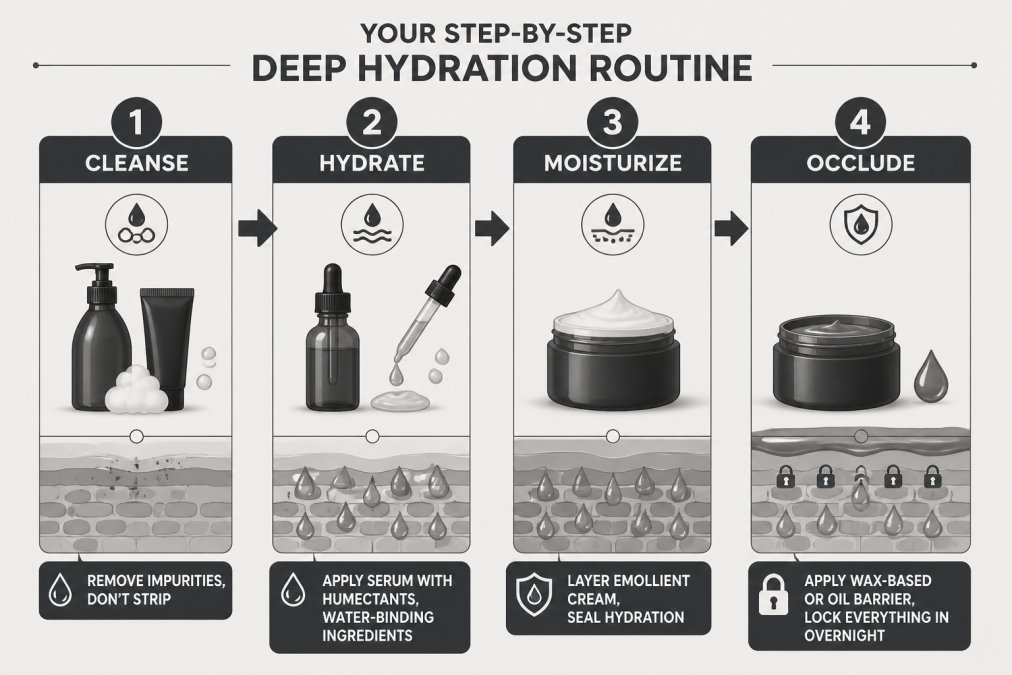
Step 1: Cleanse Without Stripping
Start with a gentle cleanser that removes dirt and oil without damaging your barrier. A creamy or oil-based cleanser is better than a foaming one when your skin is dry. Foaming cleansers are often too harsh.
Massage your cleanser in for about 30 seconds, then rinse with lukewarm water. Avoid hot water, it opens your pores and increases water loss (Impact of Water Exposure and Temperature Changes on Skin Barrier Function). Pat your skin dry gently; don't rub. Leave your skin slightly damp for the next step.
Step 2: Apply Hydrating Serums and Essences
While your skin is still damp, apply a hydrating serum. This is where humectants do their work. Apply a dime-sized amount to your face and neck, gently pressing it in rather than rubbing.
The Bioactive Prebiotics Jelly Serum works well here, it contains hyaluronic acid and prebiotics that hydrate while supporting your barrier. Let it absorb for a minute or two before moving to the next step. If your skin is very dry, you can layer two hydrating products here: a lighter serum first, then a thicker essence.
Step 3: Layer Your Moisturizer
Once your serum has absorbed, apply your moisturizer. This is your emollient layer. Use an amount about the size of a pea for your face. Gently massage it in upward motions until it's fully absorbed.
The Moisturizing Day Cream absorbs quickly without feeling heavy, making it ideal for this step. It contains multi-molecular hyaluronic acid plus soothing ingredients that calm irritated skin. In the morning, this is your final step before SPF. At night, continue to the next step.

Step 4: Seal with an Occlusive
At night, apply an occlusive over your moisturizer. This creates a protective seal that prevents water loss overnight. A small amount goes a long way, use about half a pea-sized amount for your whole face.
Occlusives feel heavy, but they're meant to. You're creating a barrier. If you have very dry skin, this step is non-negotiable. It's the difference between waking up parched and waking up hydrated.
Timing matters. Do this routine every morning and every night. Consistency is more important than perfection. Missing one application won't ruin everything, but skipping regularly will slow your results.
Common Mistakes That Prevent Deep Hydration
Applying products to completely dry skin. If your skin is bone-dry when you apply hydrating products, they don't absorb well.
Using only one hydrating product. A single serum or moisturizer isn't enough for deep hydration. You need the three-pillar approach: hydration, emollience, and occlusion.
Waiting too long between steps. If you let each product completely dry before applying the next, you lose the benefit of layering.
Skipping the barrier repair step. If your barrier is compromised, hydration alone won't help.
Changing your routine too frequently. Deep hydration takes time to work. Most people see improvement within 2-3 weeks, but full barrier repair takes 4-6 weeks.
Over-exfoliating. When skin is dry, people often exfoliate thinking it will help. Over-exfoliation damages your barrier further. Avoid physical exfoliants entirely when your skin is compromised.
When to Seek Medical Advice
Most dry skin improves with the right routine and ingredients. But sometimes, what feels like dry skin is actually a medical condition that needs professional treatment.
Seek medical advice if your skin doesn't improve after 4-6 weeks of consistent hydration and barrier repair.
If you develop an allergic reaction, sudden redness, swelling, hives, or difficulty breathing, stop using new products immediately and see a dermatologist.
Hard water can cause persistent dryness that cosmetic products alone won't fix.
Hormonal changes, medications, and underlying health conditions can cause or worsen dry skin. If your dryness started suddenly or alongside other symptoms, mention it to your doctor.
Deep hydration for dry skin isn't about finding one miracle product. It's about understanding your barrier, choosing the right ingredient categories, and applying them in the right order.
At Regnal Radiance, we've designed our hydrating products specifically for this layering approach. The Bioactive Prebiotics Jelly Serum provides deep hydration while supporting your barrier, the Moisturizing Day Cream seals in that hydration with multi-molecular hyaluronic acid and soothing ingredients, and our Anti-Aging Peptide Collection offers barrier repair alongside anti-aging benefits.

Frequently Asked Questions
How can I tell if my skin is dehydrated or just dry?
Dehydrated skin lacks water and often feels tight, flaky, or congested despite being oily in places. Dry skin is a skin type that naturally produces less oil. To check: if your skin feels uncomfortable after moisturizing but still looks dull, it's likely dehydrated. If it stays uncomfortable and rough even with hydrating products, it may be truly dry. Dehydrated skin responds quickly to hydrating serums and essences, while dry skin needs richer moisturizers with emollients and occlusives to lock in moisture.
What's the difference between hydrating and moisturizing skin?
Hydration adds water to your skin cells using humectants like hyaluronic acid and glycerin, which attract moisture from the air and deeper skin layers. Moisturizing seals that water in using emollients (like oils and butters) and occlusives (like waxes) that prevent water loss. For deep hydration of dry skin, you need both: first hydrate with serums and essences, then moisturize to lock it in. Products like the Bioactive Prebiotics Jelly Serum hydrate, while the Moisturizing Day Cream seals moisture in place.
How do I know if a moisturizer will actually penetrate and lock in moisture?
Look for multi-molecular-weight hyaluronic acid, which works at different skin depths to attract and hold water. Check for emollients like plant oils, seed butters, and natural waxes that soften skin texture. Occlusives such as beeswax or plant waxes create a protective seal. The Moisturizing Day Cream uses multi-molecular hyaluronic acid to hydrate at multiple levels while absorbing quickly into skin.
How often should I use deep hydration products for dry skin?
Apply hydrating serums and moisturizers twice daily, morning and evening, for consistent results. In winter or if your skin is very dry, you may benefit from a midday refresh using a hydrating mist like the Microbiome Prebiotics Face Mist. Consistency matters more than occasional intensive treatments; daily layering of hydration and moisture products will restore your skin barrier faster than sporadic deep treatments. Most people see visible improvement in skin texture and elasticity within 2-3 weeks of twice-daily use.