
Last Updated: November 14, 2026
Quick Summary
The best prebiotic skincare cleanser is a pH-balanced, non-comedogenic formula built on gentle surfactants that removes makeup and impurities without stripping the lipid barrier. It should leave skin soft, not tight or squeaky, and pair with prebiotic serums rather than work against them.
- Healthy skin sits around pH 4.5-5.5, so choose a cleanser that supports the acid mantle.
- Amino-acid surfactants and glucosides leave more of the lipid barrier intact than strong anionic sulfates.
- If two or more barrier warning signs appear, simplify to a gentle cleanser and basic moisturizer for one to two weeks.
- For acne, use a non-comedogenic, lipid-free cleanser that clears oil without triggering inflammation.
- Transition by swapping your cleanser in week one and adding the prebiotic serum in week two.
Table of Contents
- Why Your Cleanser Decides Whether Prebiotic Skincare Works
- What Makes a Microbiome-Friendly Cleanser for Sensitive Skin
- The Best Cleanser to Use With Prebiotic Skincare for Acne
- The Best Cleanser to Use With Prebiotic Skincare for Oily Skin
- Prebiotic vs Probiotic Skincare: What the Label Is Really Telling You
- Cleanser Comparison: Matching the Formula to Your Skin Type
- How to Transition to a Prebiotic Routine Without a Reaction
- Building Your Regnal Radiance Prebiotic Cleansing Routine
- Frequently Asked Questions
Why Your Cleanser Decides Whether Prebiotic Skincare Works
Most people treat the cleanser as the boring step before the "real" products. That's backwards. The best prebiotic skincare cleanser is the one that cleans without stripping the skin barrier your prebiotic serum is trying to feed. Get this wrong and you're paying for ingredients that never get a fair chance to work.
At Regnal Radiance, we build our prebiotic formulas around one principle: the microbiome needs a stable home. A harsh foaming wash damages that home twice a day.
The evidence backs the caution. A 2022 review of topical probiotics in PubMed Central notes that probiotic and prebiotic skincare is still regulated by its final use, not by any specific standard. Translation: the cleanser you pair with your serum matters more than the label on either bottle. Below, we'll show you exactly how to match the two.
What Makes a Microbiome-Friendly Cleanser for Sensitive Skin
A microbiome-friendly cleanser for sensitive skin is a pH-balanced, non-comedogenic formula built on gentle surfactants that removes makeup and impurities without stripping the lipid barrier. It should leave skin soft, not tight or squeaky. That definition is table stakes, the real question is which specific formulation choices actually protect the microbiome your prebiotic serum is trying to feed, and which ones quietly undermine it.
Here is what separates a genuinely microbiome-friendly formula from a marketing claim:
- Surfactant class matters more than the word 'gentle.' Amino-acid surfactants (sodium cocoyl glycinate, sodium lauroyl glutamate) and glucosides (coco-glucoside, decyl glucoside) clean effectively at skin-friendly pH while leaving more of the lipid barrier intact than strong anionic sulfates. A formula built on these is a better host for prebiotic actives than one relying on aggressive foaming agents.
- pH near skin's natural acidity. Healthy skin sits around pH 4.5-5.5. A cleanser that pushes pH up temporarily disrupts the acid mantle and the microbial balance that prebiotics are meant to support. Look for a stated pH or a formulation style (milk, gel, low-foam) consistent with that range.
- Hydration support that stays behind. Shea butter and argan oil are the hydrating ingredients listed in the Gentle Cleansing Milk.
- No unnecessary additives. Fragrance, essential-oil blends, and drying alcohols add irritation risk on reactive skin without improving cleansing. For a prebiotic routine, fewer confounding variables makes it easier to tell whether the serum is working.
A common mistake is assuming 'gentle' on a label guarantees a formula will suit your skin. Check the ingredient list. If you want a fuller list of what to avoid, our guide on ingredients to avoid for sensitive skin covers the specific offenders.
For deeper guidance on picking a formula, read our breakdown of the best gentle face wash for sensitive skin.
How to Tell If a Cleanser Is Actually Microbiome-Friendly
Most 'microbiome-friendly' claims are not backed by a standard, so you have to evaluate the formula yourself. Three practical checks:
- Read the surfactant list first. If the first cleansing ingredient is a harsh sulfate and the prebiotics appear near the end of the list, the marketing is ahead of the formula.
- Look for a stated pH or a low-foam texture. Brands that formulate around the acid mantle usually say so; milks and gels are more likely to sit in the right range than high-foam foaming washes.
- Check what the prebiotic actually is. Inulin, alpha-glucan oligosaccharide, and ferment filtrates are common; their position in the list tells you whether they are a token amount or a meaningful part of the formula.
Watch out: a cleanser can be pH-balanced and still strip skin if the surfactant load is too high for your barrier, pH and surfactant strength are separate variables, and sensitive skin needs both to be right.
Signs Your Skin Barrier Is Already Compromised
- Tightness or stinging right after washing
- Persistent redness and dryness that moisturizer can't fix
- Increased sensitivity to products you used to tolerate
- A dull, rough surface texture
If two or more of these sound familiar, your barrier needs a reset before you add anything active. In practice, that means simplifying to a gentle cleanser and a basic moisturizer for one to two weeks before reintroducing prebiotic serums, otherwise you cannot tell whether a reaction is from the new active or the damaged barrier.
The Best Cleanser to Use With Prebiotic Skincare for Acne
The best cleanser to use with prebiotic skincare for acne is a non-comedogenic, lipid-free formula that clears excess oil and pore-clogging debris without triggering inflammation.
A clinical case study on prebiotic-enriched skincare from Arome Science reported positive effects on skin microbiome composition and increased hydration. Neither of those outcomes survives a cleanser that over-dries the face.
The Best Cleanser to Use With Prebiotic Skincare for Oily Skin
For oily skin, the right cleanser is a pH-balanced foaming or gel formula that clarifies without over-cleansing. Oil control comes from balance, not from stripping.
Look for non-comedogenic formulas with gentle surfactants. Skip anything that leaves your face feeling "squeaky clean," because that sensation is damage, not cleanliness.
Prebiotic vs Probiotic Skincare: What the Label Is Really Telling You
Prebiotic skincare feeds the beneficial bacteria already living on your skin. Probiotic skincare contains live bacteria itself. The distinction matters because most products labeled 'probiotic' actually contain prebiotics, ferments, or neither, and because the category label changes what the product can realistically do in a rinse-off step versus a leave-on one.
Here's the practical breakdown:
- Prebiotics are food for your skin's existing microflora, common examples include inulin, alpha-glucan oligosaccharide, and certain plant-derived sugars. They are stable in water-based formulas, which is why they show up in cleansers, mists, and serums alike.
- Probiotics are live cultures.
- Postbiotics are the byproducts those bacteria produce.
- Fermented ingredients fall somewhere between, depending on the process and whether the live culture survives.
The Fact.MR probiotic skincare market report found that water-based formulations hold a large share of the market, which tells you consumers want lightweight, microbiome-focused textures. What the label rarely tells you is which category the product actually belongs to. Read the ingredient list.
Why the Category Label Changes What a Cleanser Can Do
This is the part most guides skip. A rinse-off cleanser has seconds of contact time; a leave-on serum has hours. That changes which category is worth paying for at each step:
- In a cleanser, prebiotics and postbiotics make sense because they are stable and can support the barrier during the wash.
- **
- A 'probiotic' cleanser is therefore usually a prebiotic or postbiotic formula with a marketing label. That is not necessarily bad, it is just not what the word implies.
How to Read the Label in Practice
- Find the prebiotic or ferment in the ingredient list. If it appears after fragrance or preservatives, the amount is likely token.
- Match the category to the step. Expect prebiotics and postbiotics in cleansers; expect prebiotics, postbiotics, or well-packaged live cultures in leave-on products.
- Treat 'probiotic' on a cleanser as a texture and marketing signal, not a live-culture claim.
This is the gap most competitor articles leave open: they explain the three categories but never connect them to contact time, stability, and which step of your routine each one actually belongs in. Once you make that connection, the cleanser decision gets simpler, you are looking for a stable, pH-balanced, prebiotic-supporting formula, not a live-culture product that cannot survive the rinse.
Cleanser Comparison: Matching the Formula to Your Skin Type
Matching a cleanser to your skin type comes down to three variables: surfactant strength, hydration level, and finish. Here's how our three microbiome-focused products map against those needs.
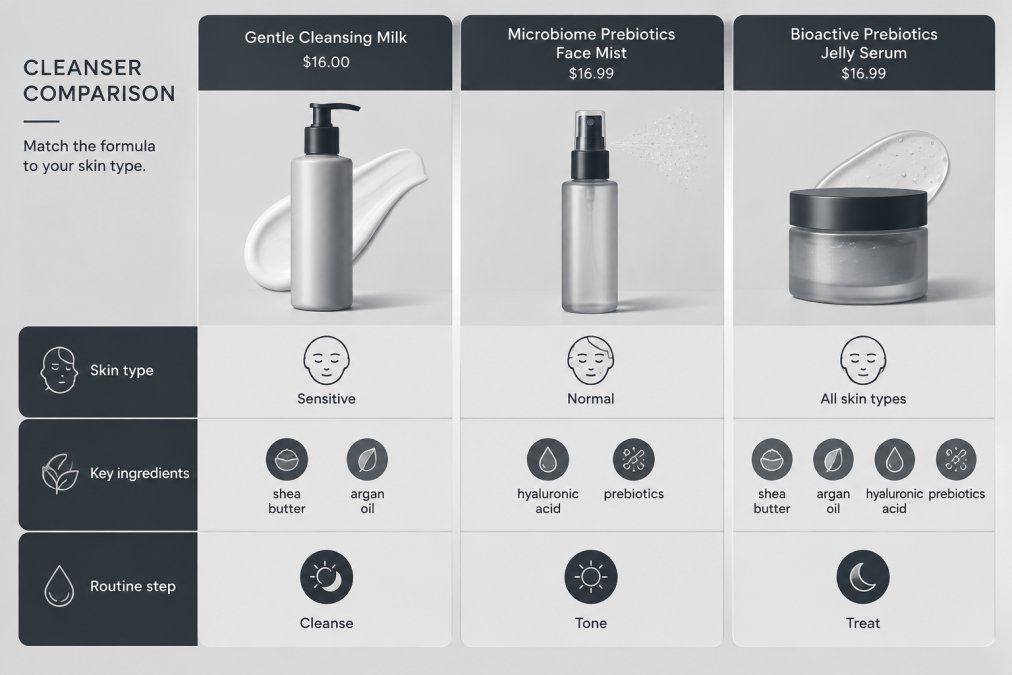
| Product | Price | Key Ingredients | Best For | Routine Step |
|---|---|---|---|---|
| Gentle Cleansing Milk | $16.00 | Shea butter, argan oil | Dry, normal, mature skin | Cleanse |
| Microbiome Prebiotics Face Mist | $16.99 | Prebiotics, hyaluronic acid | All skin types, midday refresh | Tone or refresh |
| Bioactive Prebiotics Jelly Serum | $16.99 | Prebiotics, hyaluronic acid | All skin types, barrier support | Treat |
Price
The Gentle Cleansing Milk is a silky, gentle formula that removes makeup and everyday impurities and leaves skin feeling soft, which suits dry and mature skin. The mist and serum come after cleansing to support the microbiome.
Ingredient Interactions That Undo Your Prebiotic Serum
This is the part most guides skip. Certain cleanser ingredients actively work against your prebiotic serum:
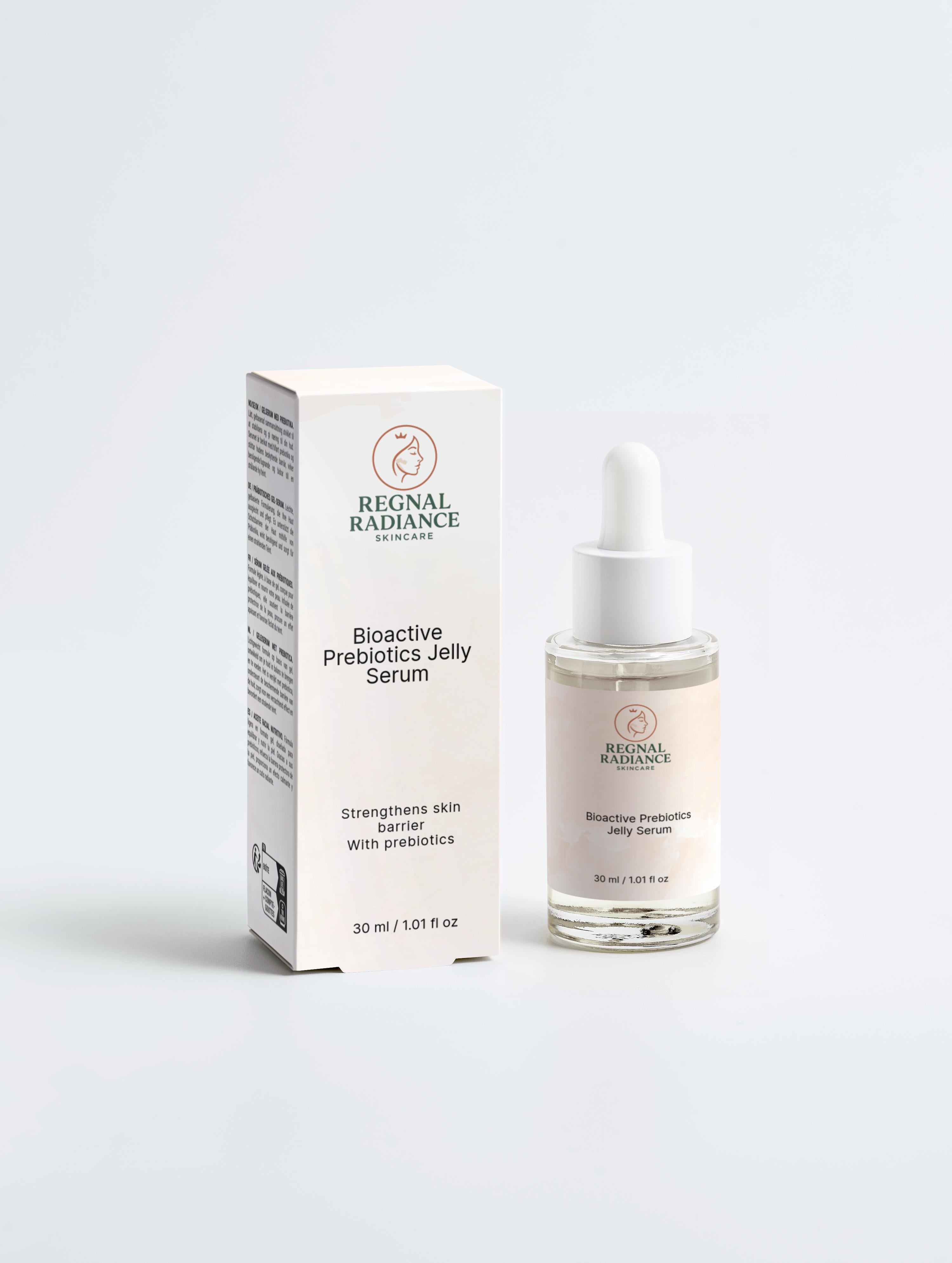
If your serum isn't delivering results, check what you're cleansing with first. The Bioactive Prebiotics Jelly Serum is built to strengthen the skin barrier and soothe redness.
How to Transition to a Prebiotic Routine Without a Reaction
Transitioning safely means changing one product at a time and giving your skin a week to respond before adding the next. Sensitive skin reacts to too much change at once, not to prebiotics themselves.
Use this sequence:
- Week 1: Swap your cleanser to a gentle, pH-balanced formula. Change nothing else.
- Week 2: Add the prebiotic serum after cleansing, morning and evening.
- Week 3: Introduce a prebiotic mist for hydration and barrier support.
- Week 4: Assess. If redness or dryness has decreased, the routine is working.
Watch out: introducing three new products in the same week makes it impossible to tell what's helping and what's irritating. Slow down.
Building Your Regnal Radiance Prebiotic Cleansing Routine
A working prebiotic routine is three steps, not ten. Here's the version we recommend:
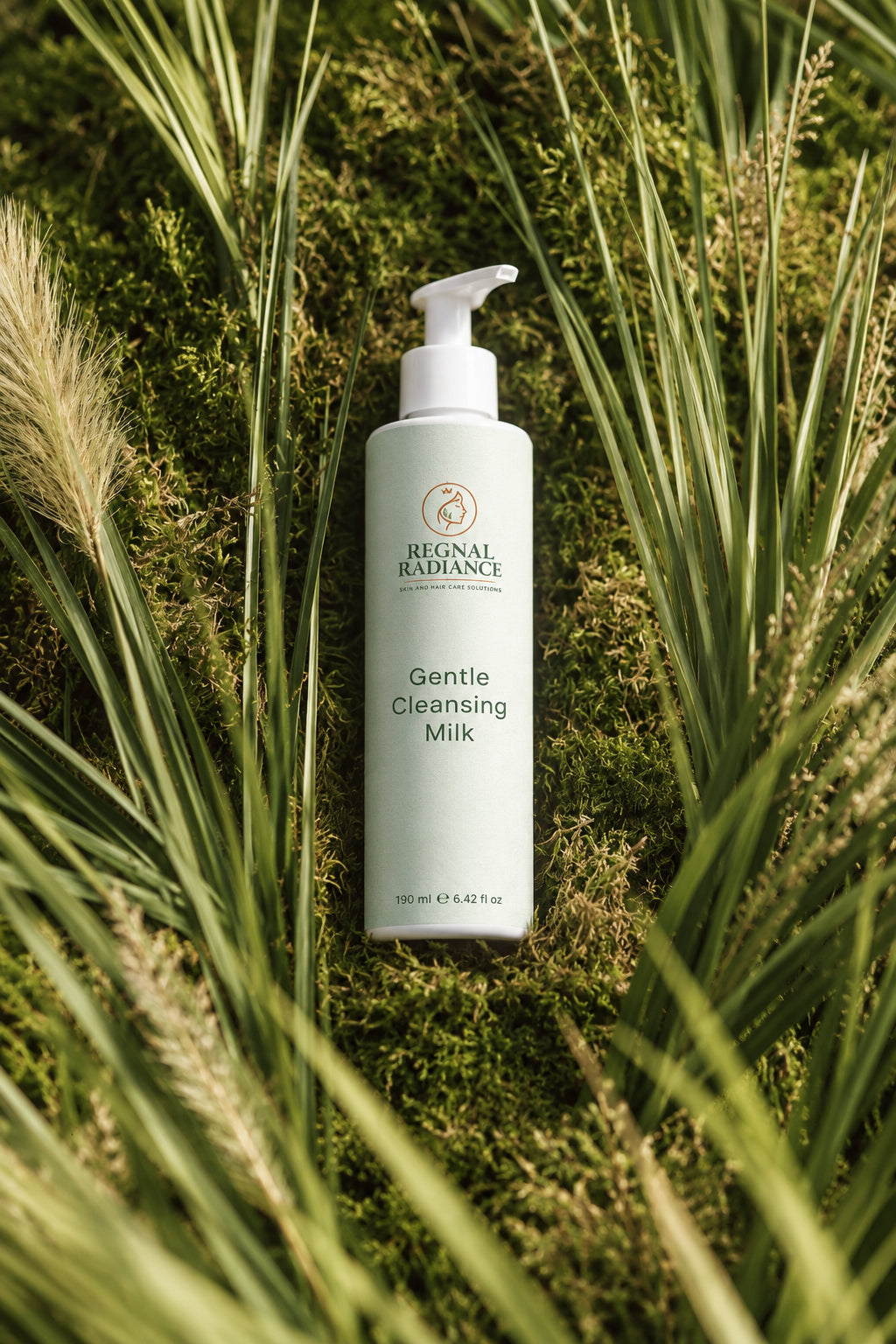
- Cleanse with the Gentle Cleansing Milk, massaging gently and rinsing with water.
- Treat with the Bioactive Prebiotics Jelly Serum, pressed into clean skin.
- Refresh and protect with the Microbiome Prebiotics Face Mist, morning and midday.
If you want the exact technique, our guide on how to use the Gentle Cleansing Milk walks through it step by step.
The throughline is simple: a clean, balanced cleanse is what makes every prebiotic step after it count. Without that foundation, the rest is guesswork.
Your skin has probably been let down by "gentle" products before. The difference here is a routine built around barrier support from the first step, not the last. Regnal Radiance makes a cleanser with shea butter and argan oil, a prebiotic serum that strengthens the skin barrier, and a prebiotic mist that hydrates and protects, all designed to work as one system for sensitive skin. Get started with Regnal Radiance and give your microbiome the stable foundation it needs to restore your natural glow.
Frequently Asked Questions
What kind of cleanser should you use with prebiotic skincare?
Use a mild cleanser that removes makeup and impurities and leaves skin feeling soft. The Gentle Cleansing Milk is a gentle option with shea butter and argan oil, suited to normal, mature, and dry skin.
Is prebiotic skincare good for sensitive skin and acne-prone skin?
The Microbiome Prebiotics Face Mist and Bioactive Prebiotics Jelly Serum are formulated for all skin types, and the Bioactive Prebiotics Jelly Serum is described as soothing redness and irritation.
What is the difference between prebiotic and probiotic skincare?
Prebiotics are ingredients that feed the microflora already living on your skin, while probiotics are live organisms added to a formula. Most shelf-stable products you see are prebiotic, because live cultures are hard to keep viable in a cleanser. Treat label claims with care and judge a formula by how your skin responds.
Should you avoid harsh cleansers when using prebiotic skincare?
Yes. Look for gentle formulas rather than harsh foaming agents, and follow with a prebiotic serum such as the Bioactive Prebiotics Jelly Serum, which is described as strengthening the skin barrier. Wash with lukewarm water, keep cleansing to twice daily, and follow immediately with a prebiotic serum such as Regnal Radiance Bioactive Prebiotics Jelly Serum to support the lipid barrier while skin is still damp.
