
Last Updated: November 1, 2026
Quick Summary
A gentle face wash removes dirt, oil and makeup while leaving the skin barrier largely intact, and creamy, fragrance-free formulas are usually the safest choice for sensitive skin. Milk or cream cleansers are the gentlest format, and patch testing any new wash for 24 to 48 hours before full use is recommended.
- Avoid fragrance, denatured alcohol and harsh sulfates, which commonly irritate sensitive skin.
- Choose a cream or milk cleanser for dry or reactive skin, since it rinses without tightness.
- Patch test a new cleanser on the jawline or behind the ear for 24 to 48 hours first.
- Wash twice a day for most sensitive skin, and reduce frequency if skin feels tight or red.
Table of Contents
- What Makes a Face Wash Gentle on Sensitive Skin
- Ingredients to Avoid for Sensitive Skin
- Choosing a Gentle Face Wash by Skin Type and Barrier Condition
- How to Patch Test Skincare Products Before Full Use
- How Often to Wash Sensitive Skin
- Our Testing Approach and What We Looked For in 2026
- Gentle Cleansing Milk: Is It the Right Gentle Face Wash for Your Routine?
- Frequently Asked Questions
Sensitive skin doesn't need a stronger cleanser. It needs a gentler one. Regnal Radiance crafts its products with clean, high-quality ingredients, so this guide explains what "gentle" actually means in a face wash and how to choose one for your skin. The product categories and sensitivity markers below come from general skincare knowledge, and the specific product details are drawn from the Regnal Radiance catalog.
What Makes a Face Wash Gentle on Sensitive Skin
A gentle face wash removes dirt, oil and makeup while leaving the skin barrier largely intact. The defining feature is not a marketing word like "gentle" on the label. It is what the formula does to skin after rinsing: whether it leaves the face feeling tight, squeaky or itchy.
Several formula traits usually signal a gentler wash:
- Low or no sulfate surfactants, which can be harsh on reactive skin
- A fragrance-free formula, since fragrance is a common irritant
- Moisturizing ingredients that stay on the skin after rinsing
- A texture that feels soft and creamy rather than foamy
Our pick for this kind of formula is the Gentle Cleansing Milk, a mild cleanser with a silky texture that removes makeup and everyday impurities. Its formula includes shea butter and argan oil, and it is positioned for normal, mature and dry skin.
Ingredients to Avoid for Sensitive Skin
Some ingredients appear in cleansers so often that people assume they are harmless. For reactive skin, a few deserve a closer look:
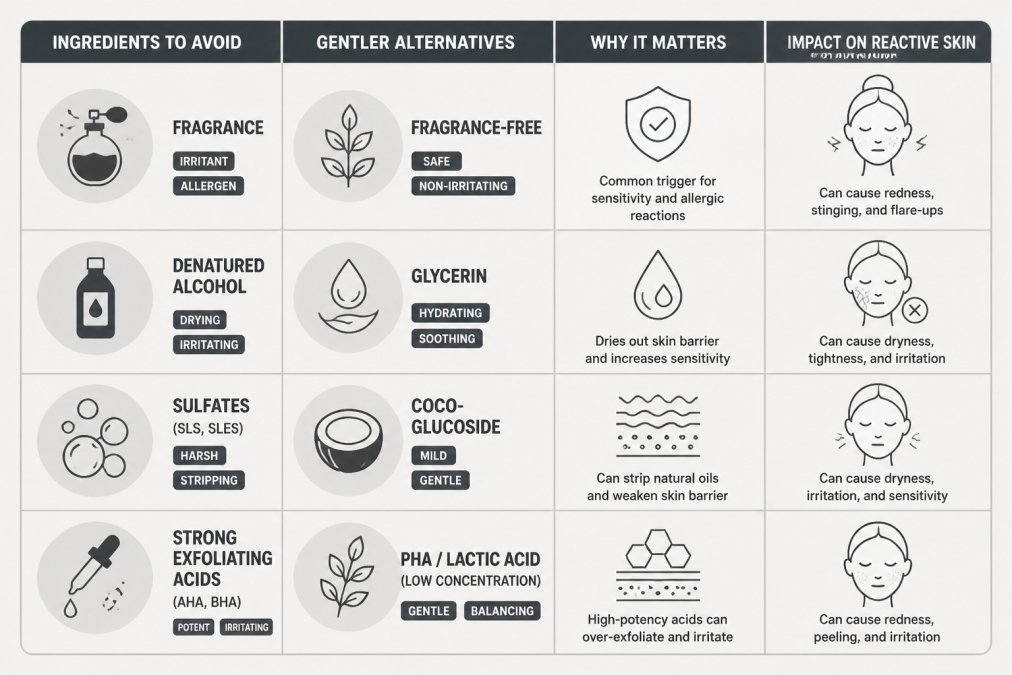
- Fragrance: A frequent cause of stinging and redness in sensitive users
- Denatured alcohol: Can leave skin dry and tight after cleansing
- Harsh sulfates: Strip oils more aggressively than gentle cleansing agents
- Strong exfoliating acids: Useful in some routines but irritating when skin is already compromised
Reading the full ingredient list matters more than scanning the front label. A "natural" or "clean" claim does not automatically mean a formula suits sensitive skin.
Choosing a Gentle Face Wash by Skin Type and Barrier Condition
Skin type describes oil production, but barrier condition describes how well the outer layer is holding water. A person with oily skin can still have a compromised barrier, and that changes which cleanser will feel comfortable.
A useful way to think about it: skin type tells you how much oil the cleanser needs to lift, while barrier condition tells you how much cushioning the formula needs to leave behind. When those two signals conflict, barrier condition should win for a few weeks, then you can reassess.
Dry and Reactive Skin
Dry and reactive skin benefits most from a cleanser that rinses off without residue or tightness. Look for creamy textures and hydrating oils. The Gentle Cleansing Milk is a gentle choice for dry skin, and its listing notes it leaves skin feeling soft. A common pattern is to use a milk or cream cleanser in the morning and a slightly richer version at night when sunscreen and makeup need to come off.
Oily and Acne-Prone Skin
Oily skin still needs a gentle wash. The mistake is reaching for a foaming, high-sulfate cleanser that leaves the face squeaky, which can trigger more oil production and irritation over time. A gel or low-foam cleanser with a mild surfactant system is usually the better fit, and it should still rinse clean without a tight after-feel. If you are actively treating acne, a gentle cleanser is the base layer of the routine, not a replacement for treatment.
Sensitive and Compromised Barrier
When the barrier feels stretched, sore, or reactive to products that used to be fine, treat cleansing as a recovery step. Prioritize fragrance-free formulas with the most moisturizing ingredients, skip anything that leaves a squeaky finish, and consider reducing to one full cleanse per day until comfort returns. This is the clearest example of why barrier condition matters more than skin type: an oily, compromised face needs the same gentle handling as a dry, compromised one.
Combination Skin
Combination skin usually does best with one gentle cleanser used consistently rather than two different formulas on different zones. A cream or milk cleanser applied to the whole face, with a slightly longer massage on the oily areas, is a common approach. If the T-zone still feels under-cleansed, a second brief pass with the same gentle formula is gentler than switching to a stronger product.
Cream, Gel and Foaming Formats Compared
Texture changes how a cleanser feels and how much it removes:
- Cream or milk cleansers: Gentlest option, good for dry and reactive skin, and suited to removing makeup
- Gel cleansers: Lighter and often used for oily skin, though some gels can feel drying
- Foaming cleansers: Remove the most oil, which is why they can be harsh on compromised skin
- Oil cleansers: Useful as a first step for sunscreen and makeup, but usually followed by a second gentle cleanse rather than used alone
If your skin feels tight after washing, a foaming format is likely too strong for you. If it feels filmy, the format may be too rich for your oil level. The goal is a middle ground: clean skin that feels comfortable a minute after rinsing.
How to Patch Test Skincare Products Before Full Use
Before committing to any new cleanser, patch test it. This is the simplest way to catch irritation before it spreads across your face.
- Apply a small amount to a discreet area, such as behind the ear or along the jawline.
- Leave it for 24 to 48 hours without rinsing.
- Watch for redness, itching, burning or bumps.
- If the area stays calm, begin using it on your full face, starting every other day.
For a detailed walkthrough of testing face serums safely, see our guide on how to patch test a new face serum.
How Often to Wash Sensitive Skin
For most sensitive skin, washing twice a day is enough: once in the morning and once at night to remove makeup, sunscreen and the day's buildup. Washing more often can strip the barrier and worsen reactivity.
Many people with reactive skin do well with a gentle rinse in the morning and a thorough cleanse at night. Adjust based on how your skin responds, and reduce frequency if you notice tightness or redness.
The article's guidance on washing frequency comes down to a few clear points:
| Time of day | Recommended approach | Purpose |
|---|---|---|
| Morning | Gentle rinse | Refresh skin |
| Night | Thorough cleanse | Remove makeup, sunscreen and buildup |
| Frequency | Twice a day for most sensitive skin | Avoid stripping the barrier |
| If tight or red | Reduce frequency | Let skin recover |
Our Testing Approach and What We Looked For in 2026
This section lays out the method behind the recommendations in this guide so you can judge whether the criteria match your own skin.
What We Mean by "Gentle"
Before scoring anything, we defined the term. A gentle face wash, for our purposes, is one that removes dirt, oil, and makeup while leaving the skin barrier largely intact. We evaluated that definition through four measurable signals:
- Surfactant system: Whether the formula relies on mild cleansing agents rather than high-sulfate systems that strip oil aggressively.
- Fragrance status: Whether the formula is fragrance-free, since fragrance is a common irritant for reactive skin.
- Post-wash feel: Whether skin feels comfortable, soft, or tight in the minute after rinsing. Tightness was treated as a negative signal regardless of how well the product cleaned.
- Residue and rinse-off: Whether the formula rinses clean without a filmy or squeaky finish.
How We Tested
Scores were assigned on a simple scale: a product could not be recommended if it left testers tight or reactive, regardless of how well it cleaned. Among products that passed that bar, we ranked by comfort after rinsing, fragrance-free status, and how well the format matched the skin types it was positioned for. This is a qualitative method, not a lab study, and we say so plainly: it is designed to reflect everyday use, not to produce a single definitive ranking.
What We Looked For in 2026
Ratings and prices change, so verify current details before buying.
Gentle Cleansing Milk: Is It the Right Gentle Face Wash for Your Routine?
The Gentle Cleansing Milk suits readers who want a soft, comforting cleanse that removes makeup without leaving skin tight. It contains shea butter and argan oil and is designed for normal, mature and dry skin. Apply it to your face, massage gently, then rinse with water.
It is a strong fit if your skin feels dry after foaming cleansers. At $16.00, it is priced as listed in the Regnal Radiance catalog. Shop the Gentle Cleansing Milk to see the full formula and how it works for your routine.

Frequently Asked Questions
How do I patch test a new face wash?
Apply a small amount of the new face wash to a discreet area such as the inner forearm or behind the ear once or twice daily for several days, rinsing as you normally would. Watch for stinging, itching, redness, bumps or tightness. If nothing develops after several days, try it on the jawline before using it across the whole face. Patch testing cannot rule out every reaction, so stop using any product that causes discomfort and seek medical advice if a reaction is severe or spreads.
What ingredients should I avoid in a face wash if I have sensitive skin?
Fragrance, including botanical extracts that are added as fragrance, is one of the most common irritants in cleansers for sensitive skin. Denatured alcohol, strong sulfate surfactants such as sodium lauryl sulfate, and harsh physical scrubs can strip the skin barrier and trigger stinging or redness. Strong exfoliating acids used at high concentrations can also irritate reactive skin. Look for fragrance-free, soap-free formulas with simple ingredient lists, and introduce any new cleanser slowly.
How often should I wash my face if I have sensitive skin?
Most people with sensitive skin do well cleansing twice a day, morning and evening, using a gentle formula with lukewarm water. Cleansing more often than that can leave skin feeling tight or look irritated, especially in dry conditions. If you wear sunscreen or makeup, cleanse in the evening to remove it fully, and rinse with water only in the morning if your skin feels stripped. Pat dry gently rather than rubbing with a towel.
What is the best face wash for sensitive skin in 2026?
The best gentle face wash depends on your skin type and barrier condition, so no single product fits every reader. Regnal Radiance's Gentle Cleansing Milk is a mild, silky cleanser with shea butter and argan oil, priced at 16.00, designed to gently remove makeup and impurities and suited to normal, mature and dry skin. Compare its texture and ingredient list against the criteria in this guide, and patch test before using it across your face.
Start with a cleanser that respects your barrier, patch test anything new, and wash no more than you need to.
