
Last Updated: October 29, 2026
Quick Summary
Yes, you can use scalp oil on color-treated hair if you choose a lightweight, low-fragrance formula and wait until the color has settled. Scalp oil supports scalp comfort and reduces dryness rather than treating color, so apply it to the scalp only and rinse with a gentle shampoo.
- Wait at least 48 hours after coloring before applying any scalp oil.
- Permanent color needs 3-5 days, demi-permanent 5-7 days, and semi-permanent 7-10 days.
- Leave oil on for 15 to 30 minutes, then rinse with warm water and gentle shampoo.
- Limit scalp oil use to once or twice a week to reduce buildup risk.
- Choose lightweight carriers like jojoba, argan, squalane, and grapeseed over heavy castor or coconut.
Table of Contents
- Can You Use Scalp Oil on Color-Treated Hair? The Direct Answer
- Does Oil Fade Hair Color? What Actually Happens
- How Soon to Oil Hair After Coloring
- Scalp Oil Before Hair Dye: What to Do at Your Appointment
- Best Oil for Color-Treated Hair: What to Look For
- How to Apply Scalp Oil Without Affecting Color
- Build a Color-Safe Scalp Oil Routine with Regnal Radiance
- Frequently Asked Questions
Can You Use Scalp Oil on Color-Treated Hair? The Direct Answer
Yes, you can use scalp oil on color-treated hair. The important part is which oil you choose and when you apply it.
Here is the direct answer in one line: color-treated hair tolerates scalp oil well when the oil is lightweight, free of harsh fragrance, and applied after the color has fully settled.
Below, we cover exactly how to do that, including timing, product selection, and the mistakes that cause fading.
Why the Type of Oil Matters More Than the Timing
Most advice online obsesses over "how soon." That is the wrong question first.
The oil itself decides more than the calendar does. Heavy, waxy oils sit on the scalp and can drag color out over time. Lightweight oils absorb and rinse clean.
A review in the International Journal of Trichology on traditional hair oil use notes that oils have a long history in scalp care, but the review does not establish that every oil suits every hair type.
That gap matters. It means you should test, not assume.
If you are also rethinking the rest of your routine, our guide on how to switch to clean haircare walks through ingredient choices step by step. For a wider look at which natural ingredients suit hair, see our breakdown of natural ingredients for hair health.
Does Oil Fade Hair Color? What Actually Happens
Oil does not usually strip color the way a harsh cleanser can. But some oils and some habits make fading more likely, and the risk is not the same for every color type.
Here is what is actually happening at the level of the hair and scalp:
- Heavy oils can trap residue. Product buildup on the scalp can interfere with how evenly color sits near the roots, especially in the first week after a service.
- Fragrance compounds may irritate. A sensitized scalp after coloring reacts more easily to synthetic fragrance, and irritation can lead to scratching, which is its own color risk.
- Castor oil is dense. Its weight can be heavy on the scalp, particularly for fine or oily hair.
The Mechanism: Why Color Type Changes the Answer
Whether oil can fade color depends on where the color lives in the hair.
- Permanent color opens the cuticle and deposits dye deep inside the cortex. A lightweight scalp oil applied after the color has settled mostly sits on the skin and does not reach the cortex, so the fading risk is low. The bigger risk is oil residue blocking even root coverage at the next appointment.
- Demi-permanent color coats the shaft without lifting the cuticle. Because the dye sits closer to the surface, repeated heavy oiling plus frequent washing can accelerate loss. A light, low-fragrance oil used once or twice a week is usually fine after the initial settling period.
- Semi-permanent color sits on the surface and fades fastest by design. This is the type most sensitive to oil-and-wash frequency. If you use semi-permanent color, treat scalp oil as an occasional treatment, not a weekly habit, and keep wash-out short.
In general, the faster-fading the color, the more the wash step matters, not the oil itself. Oil that rinses clean in one gentle wash is less risky than oil that requires several washes to remove.
What the Evidence Does and Does Not Say
A review in the International Journal of Trichology on traditional hair oil use documents a long history of oils in scalp care, but it does not establish that every oil suits every hair type or every color service. That gap matters. It means claims that a specific oil "locks in" or "strips" color should be treated as salon convention until you test it on your own hair.
So the answer to "does oil fade hair color" is: not by itself, but the wrong oil plus the wrong habits can speed it up, and semi-permanent color is the type where that shows up fastest.
How Soon to Oil Hair After Coloring
Wait at least 48 hours after coloring before you apply any scalp oil. Many colorists suggest waiting longer, and the right window depends on the type of color you had.
Why the wait? Color needs time to settle into the hair shaft. Oiling too early can interfere with that process.
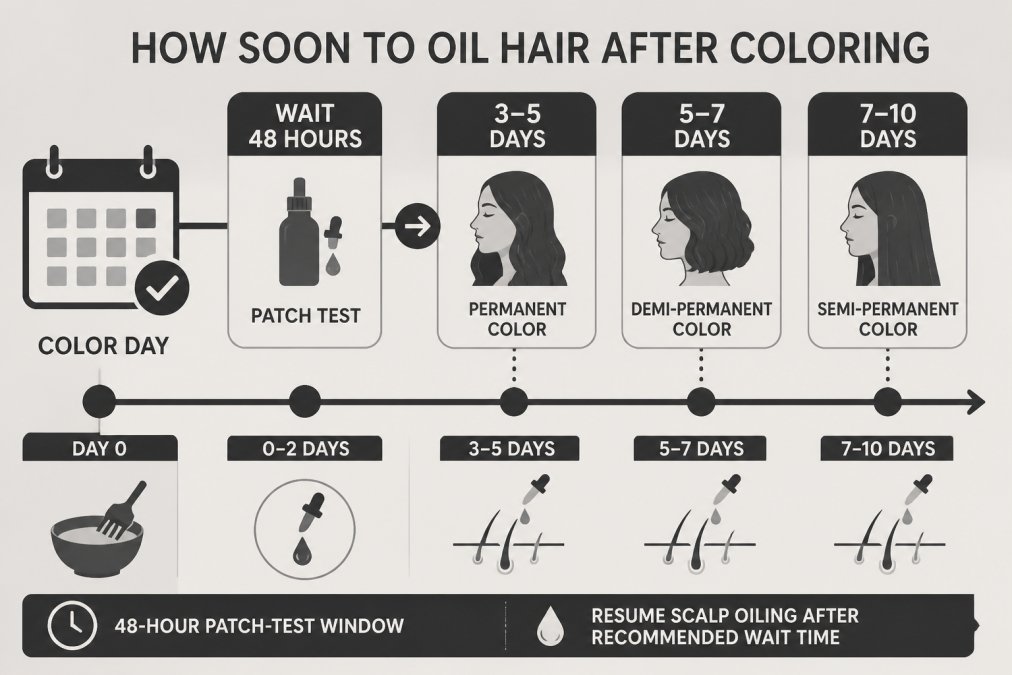
Timing by Color Type: Permanent, Demi-Permanent, and Semi-Permanent
Different color types behave differently. Here is how we would plan it:
| Color Type | How It Works | Wait Before Oiling | First Application |
|---|---|---|---|
| Permanent | Opens the cuticle, deposits color deep | 3-5 days | Light layer, patch test first |
| Demi-permanent | Coats the shaft, no ammonia lift | 5-7 days | Light layer, patch test first |
| Semi-permanent | Sits on the surface, fades fastest | 7-10 days | Light layer, patch test first |
The pattern is simple. The longer-lasting the color, the sooner your scalp can handle oil. The faster-fading the color, the more cautious you should be.
Always patch test on a small area first, even if you have used the oil before.
Scalp Oil Before Hair Dye: What to Do at Your Appointment
Ask your colorist before you apply anything. That is the short version.
Some salons apply a protective barrier to the scalp before color. Others prefer clean, product-free hair. Your colorist knows which approach suits your formula.
Here is what we suggest:
Rosemary Hair & Scalp Strengthening Oil →
- Ask first. A quick question at booking saves a wasted appointment.
- Skip heavy oils 24 hours before. Oil residue can block dye absorption near the roots.
- Wash normally the day before. Clean hair gives more predictable results.
Watch out: applying a thick oil the morning of your appointment can leave residue that keeps color from taking evenly at the roots.
Best Oil for Color-Treated Hair: What to Look For
The best oil for color-treated hair is lightweight, low-fragrance, and formulated for scalp use. Lighter oils are generally gentler choices than heavy waxy oils. But "gentle" is not a spec, so check the ingredient list.
Read the Ingredient List, Not the Front Label
Color-safe selection comes down to three things on the back of the bottle:
- Carrier oil weight. Jojoba, argan, squalane, and grapeseed are light and rinse clean. Castor, coconut, and shea are heavier and more likely to leave residue that needs a stronger wash. For color-treated hair, lighter carriers reduce the wash frequency that actually fades color.
- Fragrance position. If "fragrance" or "parfum" appears high on the list, the formula is more likely to irritate a scalp that is still settling after a color service. Fragrance-free or naturally scented formulas are the safer default in the first two weeks.
- Essential-oil load. Rosemary and peppermint are popular for scalp stimulation, but essential oils are a known irritation risk for some people, especially on a freshly colored scalp. A short contact time (15 to 30 minutes) and a patch test matter more than the essential-oil blend itself.
A Color-Safe Selection Checklist
Use this when you shop:
- Lightweight carrier oil (jojoba, argan, squalane, grapeseed) rather than a thick butter or wax
- No strong synthetic fragrance, or fragrance listed low on the ingredients
- Formulated for scalp use, not just hair ends
How This Plays Out in Practice
Our Rosemary Hair & Scalp Strengthening Oil blends rosemary and peppermint oils.

That short contact time is the key. You get scalp nourishment without leaving heavy residue behind, and you avoid the multi-wash cycle that does the real fading damage.
If you are also rethinking the rest of your routine, our guide on how to switch to clean haircare walks through ingredient choices step by step.
How to Apply Scalp Oil Without Affecting Color
Follow these steps and you will get the scalp benefit without the color risk.
- Start with dry, detangled hair. Section it so you can reach the scalp.
- Apply to the scalp only. Use a dropper or your fingertips, not the hair lengths.
- Massage gently for one to two minutes. This helps the oil spread evenly.
- Leave it 15 to 30 minutes. Longer is not better for color-treated hair.
- Rinse with a gentle shampoo. Warm water, not hot.
- Limit to once or twice a week. More frequent use raises buildup risk.
Troubleshooting: Buildup, Itching, and Residue
Buildup and itching usually mean one of three things: too much oil, too often, or a shampoo that is not cleansing enough. For a deeper reset, our Deep Cleanse Scalp Scrub, Rosemary & Mint gently removes buildup and helps reduce dandruff.
Try these fixes:
-
Reduce the amount. A few drops go further than most people expect.
-
Switch your wash step. Our Sensitive Scalp Shampoo is made for dry, sensitive scalps and is COSMOS Natural certified. It gently cleanses without stripping natural oils.

Sensitive Scalp Shampoo -
Stop if irritation persists. Persistent itching or redness after coloring deserves a dermatologist's opinion, not another product.
Watch out: layering oil, dry shampoo, and styling products without a proper wash day is the fastest route to a flaky, itchy scalp.
Build a Color-Safe Scalp Oil Routine with Regnal Radiance
A color-safe routine is not complicated. It is consistent.
Here is the shape of it:
- Wash day: gentle shampoo, warm water, no harsh scrubbing
- Oil day: scalp only, 15 to 30 minutes, rinse well
- Between washes: keep styling products light
That rhythm keeps your scalp comfortable and your color intact.
Our Hair Care Ritual Bundle brings a full routine together: the Sensitive Scalp Shampoo, the Rosemary Hair & Scalp Strengthening Oil, a volume conditioner, and a dry shampoo for non-wash days.
The challenge most people face is building a routine gentle enough for a sensitive scalp and strong enough to keep color looking fresh.
Get started with Regnal Radiance and give your scalp a routine it can actually tolerate.
Frequently Asked Questions
How soon after coloring your hair can you use scalp oil?
Wait at least 3 to 5 days after a permanent color service before applying scalp oil, and 7 to 10 days after semi-permanent color. Freshly colored strands are more porous and the cuticle is still settling, so early oiling can interfere with how the color locks in. If your scalp feels tight or itchy in the first few days, use a gentle, fragrance-free shampoo instead and save the oil for once the color has stabilized.
Can scalp oil make hair dye fade faster?
Lightweight oils applied to the scalp generally do not fade color on their own, but heavy, waxy oils and oil-based products left on the hair lengths can lift dye over time by loosening the cuticle and encouraging wash-out. The bigger risk is product buildup that traps pigment unevenly. Stick to a small amount of a light oil like argan or jojoba on the scalp, keep it off the mid-lengths and ends, and wash it out within 15 to 30 minutes.
Which oils are safe for color-treated hair?
Lightweight, non-comedogenic oils are the safest bet: argan, jojoba, and rosemary-based blends are commonly recommended for color-treated hair because they absorb without leaving a heavy film. Avoid castor oil directly on the scalp, especially if your hair is fine or your scalp tends oily, because its density can overwhelm the roots. Skip oils with added synthetic fragrance if your scalp is sensitized from coloring, since fragrance compounds are a common irritation trigger.
Should you oil your scalp before a salon color appointment?
No. Arrive with clean, product-free hair so the dye can penetrate evenly. Oil residue on the scalp can create a barrier that leads to patchy color uptake, and it may also interfere with the protective barrier your colorist applies. If your scalp is sensitive, ask your colorist about a barrier cream at the appointment instead of pre-oiling at home. Save the scalp oil for the days and weeks after coloring, not before.
