
Quick Summary
A peptide skincare routine for early fine lines pairs a peptide serum with moisturizer and daily SPF, introduced slowly and kept consistent for 8 to 12 weeks. Signal peptides are the logical starting point because they are designed to support collagen and elastin production.
- Introduce one new active at a time and wait two to three weeks before judging it.
- Signal peptides are designed to prompt the skin to produce more collagen and elastin.
- Keep the routine steady for at least 8 to 12 weeks before reassessing results.
- Patch test on the jawline or inner forearm for three to five days before full-face use.
- Take a photo in the same lighting every two weeks to track changes.
Table of Contents
- How to Build a Peptide Routine for Early Fine Lines
- What Peptides Do in Skin Care and What the Evidence Shows
- How to Introduce Peptides into Your Skincare Routine
- Best Peptides for Anti Aging and How to Choose by Skin Type
- Layering Order, Compatibility and Patch Testing
- Best Peptide Serum for Collagen Production: What to Look For
- A Realistic Timeline for Early Fine Lines and How to Track Progress
- Peptide Skincare Routine for Early Fine Lines: Reviews of Regnal Radiance Options and Your Next Step
- Frequently Asked Questions
How to Build a Peptide Routine for Early Fine Lines
Last Updated: November 17, 2026
What Peptides Do in Skin Care and What the Evidence Shows
Peptides are short chains of amino acids that skin care formulators use to signal skin to repair and rebuild. This guide walks through how a peptide skincare routine for early fine lines fits into an everyday regimen.
The research picture is promising but incomplete. A review in Aesthetic Surgery Journal Open Forum reports improved appearance of fine lines and wrinkles, elasticity, texture, and skin thickness with topical peptides, while also noting potential for accelerated wound healing. A separate ScienceDirect systematic review from 2026 says stability, compatibility, safety, efficacy, and application still need more research. That gap matters. Peptide results are real in some studies, but they are not uniform across every product.
Signal, carrier and enzyme-inhibiting peptides explained
Peptides used in skin care fall into a few functional groups. Signal peptides are designed to prompt the skin to produce more collagen and elastin. Carrier peptides are meant to deliver trace minerals such as copper to the skin. Enzyme-inhibiting peptides aim to slow the enzymes that break down collagen over time.
Knowing the group helps you set expectations. A signal peptide is a logical choice for early fine lines. An enzyme-inhibiting peptide works on a different part of the same process.
How to Introduce Peptides into Your Skincare Routine
Introduce one new active at a time and give your skin two to three weeks before judging it. Start with a single peptide serum applied to clean skin each evening, then add a daytime SPF once your skin is comfortable.
A simple starting routine looks like this:
- Week 1-2: Cleanser, peptide serum at night, moisturizer
- Week 3 onward: Add a daytime SPF every morning
- Ongoing: Keep the routine steady for at least 8 to 12 weeks
Regnal Radiance's Anti-Aging Peptide Collection includes a serum, eye cream, and AM/PM cream. Once you have the basics in place, the How to Use a Peptide Serum With a Prebiotic Face Mist guide explains how to add a mist without disrupting the serum.
Best Peptides for Anti Aging and How to Choose by Skin Type
No single peptide suits every skin type, and the best choice depends on how your skin behaves rather than on the longest ingredient list. A useful way to choose is to match the peptide function to your main concern, then match the base formula to your skin type.
For early fine lines, signal peptides are the most logical starting point because they are designed to support collagen and elastin production. Carrier peptides, such as copper peptides, are often included in firmness-focused formulas, while enzyme-inhibiting peptides are used in products aimed at slowing collagen breakdown. If your concern is texture and dehydration alongside fine lines, a peptide serum with hyaluronic acid is a practical combination.
Skin type changes the base formula more than the peptide itself. Dry skin usually does better with a peptide serum layered under a richer moisturizer that contains humectants and emollients. Oily and acne-prone skin often prefers a lightweight, water-based peptide serum and a gel-cream moisturizer, and should avoid heavy occlusive layers that can trap oil. Sensitive skin needs the fewest extras: a short ingredient list, no added fragrance if you know you react to it, and a slow introduction. Mature skin may benefit from a peptide serum plus an eye cream and a moisturizer with barrier-supporting ingredients.
Regnal Radiance's Anti-Aging Peptide Collection includes a Peptide Anti-Aging Serum with 2% Hexapeptide-11 and is described as suitable for all skin types, including mature and dehydrated skin. For dry skin, the Regnal Radiance Moisturizing Day Cream contains multi-molecular-weight hyaluronic acid and bisabolol, and its listing describes it as suited to normal to dry skin. If your skin is oily, use a thinner layer of the serum and a lighter moisturizer rather than skipping moisturizer entirely.
Watch out: a product labeled for all skin types can still irritate sensitive skin if it is applied too often at first. Start with every other evening and build up.
A simple decision guide looks like this: choose a signal-peptide serum for fine lines, add a barrier-supporting moisturizer for dryness, keep the formula lightweight for oiliness, and prioritize a short ingredient list and patch testing for sensitivity. Once you have chosen a serum, the How to Use a Peptide Serum With a Prebiotic Face Mist guide explains how to add a mist without disrupting the routine.
Layering Order, Compatibility and Patch Testing
Layering is where a peptide routine either works smoothly or turns into irritation. The general rule is thinnest to thickest, water-based before oil-based, and sunscreen last in the morning. For a peptide-focused routine built around early fine lines, that translates into a repeatable order you can follow without guessing.
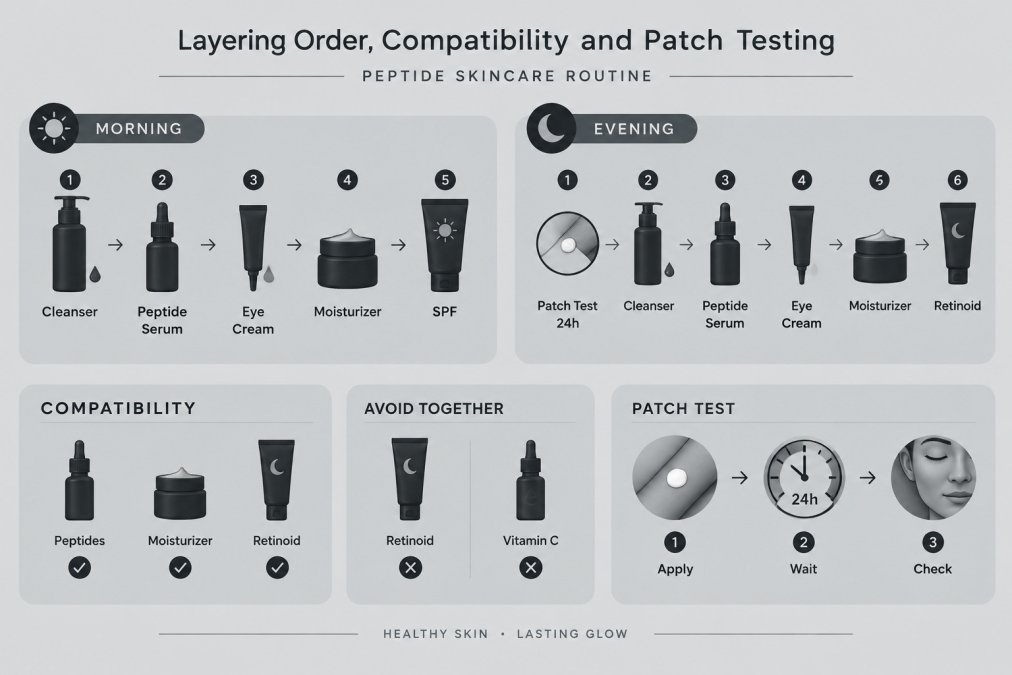
A practical morning sequence is: cleanser, optional hydrating toner or mist, peptide serum, eye cream, moisturizer, then sunscreen. At night, the same sequence applies without sunscreen. If you use a prescription or over-the-counter retinoid, the common pattern is to apply the peptide serum first, let it absorb, then apply the retinoid, and finish with moisturizer. Some people prefer to alternate nights instead, especially when their skin is reactive.
Ingredient compatibility is more nuanced than the blanket advice that peptides conflict with acids. Many peptide formulas are stable at the pH ranges found in well-formulated serums, but strong exfoliating acids and high-strength retinoids can increase irritation when stacked in the same routine. A safer approach is to separate them by time of day or by alternating evenings, rather than assuming every combination is forbidden. Vitamin C is generally compatible with peptides in the morning, but if your skin stings when they are layered directly, apply one, wait a minute, and follow with the other.
Watch out: do not layer a peptide serum, a strong acid, and a retinoid in the same evening when you are first introducing peptides. That combination makes it hard to tell which product is causing redness or flaking.
Patch testing deserves its own step. Apply a small amount to the jawline or inner forearm for three to five days before using it on the full face. Stop if you see persistent redness, stinging, or swelling. For the eye area, use a dedicated eye cream rather than a face serum, and keep the application to the orbital bone rather than the lash line.
The table below summarizes a simple peptide routine for early fine lines.
| Step | Morning | Evening | Purpose |
|---|---|---|---|
| Cleanse | Yes | Yes | Clear the surface |
| Peptide serum | Yes | Yes | Target early fine lines |
| Eye cream | Yes | Yes | Delicate eye area |
| Moisturizer | Yes | Yes | Lock in hydration |
| SPF | Yes | No | Protect from UV |
Sun protection finishes the morning routine. The Regnal Radiance Sun Protection SPF50 Stick, with tint is a mineral-based, tinted option that is listed as gentle enough for sensitive skin. For combining actives safely, the 7 Rules for Layering Niacinamide and Peptide Serum and How to Patch Test a New Face Serum Safely guides cover the details.
Best Peptide Serum for Collagen Production: What to Look For
When comparing peptide serums for collagen support, look at the peptide type, the concentration, and the rest of the formula. Concentration matters, but so does how the product is used every day.
Regnal Radiance's Peptide Anti-Aging Serum lists 2% Hexapeptide-11, Hyaluronic Acid, and Ginkgo Biloba extract. Apply it to clean skin morning and/or evening and pat gently until absorbed. Compare the full ingredient list against your own priorities before choosing.
Peptide evidence for collagen is still developing. Treat any serum as one part of a routine, not a guaranteed fix.
A Realistic Timeline for Early Fine Lines and How to Track Progress
Expect gradual change over months, not days. Many people reassess after 8 to 12 weeks of consistent use. Take a photo in the same lighting every two weeks so you can compare changes that are hard to notice day to day.
Track three things: how the lines look in your photos, how your skin feels in terms of firmness and hydration, and whether any irritation appears. If you see no change after three months, or if irritation persists, speak with a dermatologist.
Peptide Skincare Routine for Early Fine Lines: Reviews of Regnal Radiance Options and Your Next Step
A consistent peptide skincare routine for early fine lines usually means a serum or eye cream, a moisturizer, and daily SPF, introduced slowly and tracked honestly. Regnal Radiance's options include the Anti-Aging Peptide Collection, the Moisturizing Day Cream, and a tinted SPF. Start with one product, patch test it, and give your skin the time it needs to show you what works.
Frequently Asked Questions
What peptides help with fine lines and wrinkles?
Peptides studied for visible aging signs include signal peptides, which are thought to support collagen-related activity, and carrier peptides, which deliver trace elements to the skin. Topical peptide reviews report improvements in the appearance of fine lines, elasticity and texture, but the authors also note that stability, safety and efficacy still need more research. Look for a clearly labelled peptide (such as Hexapeptide-11 in the Peptide Anti-Aging Serum) and set realistic expectations for early fine lines.
Do peptides actually work for wrinkles?
Evidence is encouraging but not conclusive. A systematic review of randomized controlled trials on oral and topical peptide therapies for skin aging examined wrinkles, elasticity and roughness, while a separate review reports improved appearance of fine lines and wrinkles with topical peptides. Results vary by formula and concentration, and a 2026 systematic review still calls for more research into peptide stability and efficacy. Treat peptides as a supportive step alongside daily SPF, not a guaranteed fix.
Can you use peptides with retinol?
Many people use peptide serums and retinol together, usually by applying the peptide serum first and the retinol at night, with moisturizer after. Introduce one active at a time and patch test first, since sensitive skin can react to combined actives. If irritation appears, pause one product. A moisturizer can serve as a final layer after your serum.
How long does it take to see results from peptide skincare?
Most people need consistent daily use for several weeks before judging a peptide routine, and clinical timelines for topical products are generally measured in months rather than days. Track progress with dated photos in the same lighting and note skin texture and hydration over time. Pair the routine with daily sun protection, such as the Sun Protection SPF50 Stick with Tint, since sun exposure drives much of early fine-line formation.
