
Last Updated: November 8, 2026
Quick Summary
A prebiotic serum feeds the beneficial bacteria living on your skin, supporting microbial balance and barrier function. It is not a probiotic: prebiotics are non-living ingredients that nourish skin's resident microorganisms, while probiotic products usually deliver dead or dormant ferments. Used morning and evening before moisturizer, a prebiotic serum supports barrier strength, hydration and calmer redness.
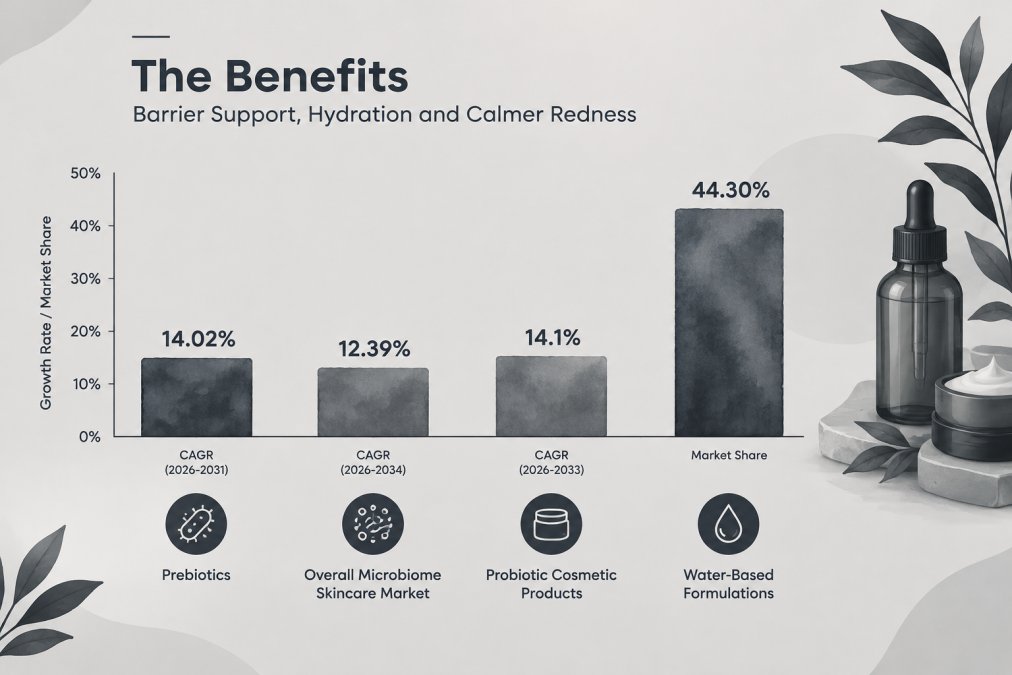
- Prebiotics are the fastest-growing microbiome ingredient category, forecast at a 14.02% CAGR from 2026 to 2031.
- Use a prebiotic serum after cleansing and toning, before moisturizer, morning and evening.
- Press a pea-sized amount into face and neck rather than rubbing it in.
- Give the serum four weeks before judging results, since barrier support is cumulative.
- Patch test on your inner forearm for 48 hours before applying to your face.
Table of Contents
- What a Clean Beauty Prebiotic Serum Actually Does
- Prebiotics vs Probiotics in Skincare: The Difference That Matters
- The Benefits: Barrier Support, Hydration and Calmer Redness
- Why a Prebiotic Serum for Sensitive Skin Is Worth Trying
- How to Use a Prebiotic Serum in Your Routine
- Reading a Clean Beauty Face Serum Label Before You Buy
- Who Should Be Cautious, and How to Patch Test
- Building Your Microbiome Routine with Regnal Radiance
- Frequently Asked Questions
What a Clean Beauty Prebiotic Serum Actually Does
A clean beauty prebiotic serum is a topical formula that feeds the beneficial bacteria living on your skin, and the market is responding fast: Fortune Business Insights projects the microbiome skincare market will grow from $556.11 million in 2026 to $1,415.39 million by 2034, a 12.39% CAGR. At Regnal Radiance, we built our serum line around that exact premise: support the skin ecosystem first, and visible radiance follows. A prebiotic serum is a leave-on topical skincare product that supplies non-living ingredients which selectively nourish the skin's resident microorganisms, helping to support microbial balance and barrier function. It is not a probiotic, and that distinction matters more than most labels admit.
Prebiotics, Probiotics and Postbiotics: What the Label Means
Prebiotics are nutrients that feed beneficial bacteria. Probiotics are live microorganisms, which are difficult to keep viable in a water-based cosmetic. Postbiotics are the byproducts those microbes produce.
Water-based formulations account for roughly 44.30% of the probiotic skincare market in 2026, according to Fact.MR's probiotic skincare analysis, which tells you something practical: most "probiotic" serums you pick up are not live cultures at all. They are ferments and lysates. That is not a scandal, but it does mean the label deserves a careful read.
Prebiotics vs Probiotics in Skincare: The Difference That Matters
The difference is simple: prebiotics feed the skin ecosystem, while probiotics attempt to add live bacteria to it. Prebiotics are the more stable bet in a bottle that sits in your bathroom for months.
Here is where most guides get it wrong. They frame prebiotics as the "gentler alternative" to probiotics, as though you are choosing between two strengths of the same thing. You are not. A prebiotic supports the natural defenses your skin already has. A probiotic product, in practice, usually delivers dead or dormant ferments. Both can help, but only one is doing what the word implies.
Prebiotics are also the fastest-growing ingredient category in this space. Mordor Intelligence forecasts prebiotics will grow at a 14.02% CAGR from 2026 to 2031, the highest rate among microbiome-skincare ingredient types. Formulators are following the evidence, and the evidence points toward feeding the skin rather than seeding it.
The Benefits: Barrier Support, Hydration and Calmer Redness
Three benefits show up consistently: barrier support, moisture retention, and calmer redness. A review indexed by the National Library of Medicine reports that prebiotic oligosaccharides applied topically may enhance skin hydration, attenuate acne, and protect against photo-related effects.
What the Evidence Shows and Where It Stops
The evidence is promising but smaller than marketing suggests. A two-week prospective study found that twice-daily use of a Lactobacillus ferment lysate-derived prebiotic mist and serum significantly reduced facial erythema, though the published summary gives no sample size or numerical reduction. A separate Arome Science skin microbiome case study reported positive effects on microbiome composition and increased hydration, again without a numerical result.
Why a Prebiotic Serum for Sensitive Skin Is Worth Trying
What most guides miss is that sensitive skin often reacts to the number of actives, not just the type. A short, barrier-supporting routine beats a stacked one. If your skin stings after three products, adding a fourth is not the answer.
How to Use a Prebiotic Serum in Your Routine
Use a prebiotic serum after cleansing and toning, before moisturizer, morning and evening. Press it in rather than rubbing, and follow with a moisturizer to lock in hydration. That is the short version. The longer version matters more, because a prebiotic serum is a leave-on support step, not an active treatment, and how you layer it changes what it can do.
- Cleanse with a gentle, non-stripping cleanser. If your skin feels tight after cleansing, the cleanser is doing more damage than the serum can repair.
- Apply toner if you use one, and let it absorb. A hydrating toner can help, but an astringent or high-alcohol toner works against the barrier-support goal.
- Dispense a small amount of serum and press into face and neck. A pea-sized amount is usually enough for the full face; more does not improve results and can make layering feel heavy.
- Follow with moisturizer to seal in moisture. The serum supplies humectants and prebiotic ingredients; the moisturizer supplies the occlusive or lipid layer that keeps water from evaporating.
- Use morning and evening, and give it four weeks before judging results. Barrier and microbiome support is a cumulative process, not a one-week fix.
Application order and layering. The general rule is thinnest to thickest: cleanser, toner, water-based serum, treatment serums, moisturizer, then sunscreen in the morning. A prebiotic serum usually belongs in the water-based serum step. If you also use an exfoliating acid or a retinoid, decide which one your skin tolerates best and do not stack them in the same routine at first. A common pattern is to use the prebiotic serum in the morning and the active treatment at night, or to alternate nights, so the barrier-support step is not competing with a stripping or renewing step on the same skin.
Frequency. Twice daily is reasonable for most people, but start once daily if your skin is reactive. There is no benefit to applying a prebiotic serum more often than the label recommends; the ingredients are not dose-escalating actives, and over-application mainly increases the chance of pilling or irritation from repeated handling.
Compatibility. Prebiotic ingredients such as oligosaccharides, inulin, and ferment lysates are generally compatible with humectants like hyaluronic acid and glycerin, with niacinamide, and with most moisturizers. The bigger compatibility question is the rest of your routine: high-concentration acids, benzoyl peroxide, and strong retinoids can compromise the barrier that the serum is meant to support. If you use them, space them out rather than layering everything at once.
What to avoid. Do not apply a prebiotic serum to damp skin straight from the tap and expect better absorption. Hard water minerals can leave residue that interferes with how a formula sits. Pat skin mostly dry first. Do not mix the serum into your moisturizer in your hand unless the label says it is fine to do so; some formulas are tested for layering, not for mixing.
Watch out: If your skin stings, turns red, or feels tight within minutes of applying the serum, stop and reassess the whole routine rather than adding another product. A prebiotic serum is meant to reduce reactivity, not create it.
A simple routine template. Morning: gentle cleanser, prebiotic serum, moisturizer, sunscreen. Evening: gentle cleanser, prebiotic serum, moisturizer. If you use an active, put it in the evening routine on alternate nights and keep the prebiotic serum in the morning. This keeps the routine short enough to identify what is helping and what is not.
Reading a Clean Beauty Face Serum Label Before You Buy
A clean beauty face serum label tells you what the formula contains, but "clean beauty" itself has no single official regulatory definition. A consumer guide from Doctor Rogers makes this point directly: no official body governs the term, so it establishes no uniform standard. Cosmetics & Toiletries has even framed whether pre-, pro-, and postbiotic skincare claims should be regulated as an open debate.
So read past the front of the bottle. Check the ingredient list for prebiotic names such as oligosaccharides, ferment lysates, and inulin. Look for fragrance listed high, which is a common irritation trigger. For a fuller explanation of what the term should mean, our guide on why clean beauty is better in 2026 breaks it down.
| Label Claim | What It Usually Means | What to Check |
|---|---|---|
| "Prebiotic" | Contains microbe-feeding ingredients | Named prebiotic in the list |
| "Probiotic" | Usually ferments or lysates, not live cultures | Strain or ferment name |
| "Clean" | No regulated definition | Full ingredient list |
| "Fragrance-free" | No added scent | "Fragrance" or "parfum" absent |
| "Barrier support" | Marketing language | Humectants and prebiotics present |
Who Should Be Cautious, and How to Patch Test
Anyone with known allergies to a specific botanical or ferment should be cautious, and patch testing is the sensible first step for everyone else. Prebiotic serums are generally well tolerated, but "generally" is not "always."
Patch test on your inner forearm for 48 hours before applying to your face. Apply a small amount, leave it, and check for redness, itching, or swelling. If you react, stop. Our step-by-step guide on how to patch test a new face serum safely walks through the full process, and if you know your skin reacts easily, our list of ingredients to avoid for sensitive skin is worth reading before you shop.
Building Your Microbiome Routine with Regnal Radiance
A microbiome routine works best when the steps reinforce each other rather than competing. That is the throughline of everything above: fewer, better-chosen products that support barrier function instead of stripping it.
Our Bioactive Prebiotics Jelly Serum is a lightweight, gel-based formula with prebiotics and hyaluronic acid, designed to strengthen the skin's protective barrier, soothe redness, and support a balanced microbiome. It absorbs quickly and leaves no residue. Pair it with our Microbiome Prebiotics Face Mist for a midday refresh or to set makeup.


The broader category is expanding quickly. Grand View Research projects the probiotic cosmetic products market will grow from $376.3 million in 2026 to $946.4 million by 2033 at a 14.1% CAGR. Plenty of those bottles will overpromise. The ones worth your money will name their prebiotics, skip the fragrance, and ask for four weeks rather than four days.
The challenge is not finding a prebiotic serum. It is finding one whose formula matches its claims. Regnal Radiance builds clean, high-quality formulas without unnecessary additives, designed for all skin types, with prebiotics and hyaluronic acid doing the barrier and hydration work. Start with the Jelly Serum, add the Face Mist when you want a refresh, and give your skin a month to respond. Get started with Regnal Radiance and build a routine your skin can actually sustain.
Frequently Asked Questions
What does a prebiotic serum do to your face?
A prebiotic serum feeds the beneficial bacteria already living on your skin rather than adding new ones. Expect gradual change, not an overnight fix.
How is a prebiotic serum different from a probiotic serum?
Probiotic serums contain live or lysed bacteria; prebiotic serums contain ingredients that feed the bacteria already on your skin. Prebiotics feed the bacteria already on your skin, while probiotics introduce new cultures.
Can prebiotic skincare help sensitive or dry skin?
Patch test first, and give any new prebiotic serum a few weeks before judging results.
How long might it take to notice a difference from prebiotic skincare?
Results vary, so photograph your skin in the same light each week so you can judge change against a baseline rather than memory.
