
Table of Contents
- Is Luxury Skincare Worth the Price? The Verdict
- What Accounts for the Higher Price of Luxury Products
- Luxury vs Drugstore Skincare Ingredients: What's the Real Difference
- Are Expensive Face Creams Worth It? Cost Per Use and Real-World Value
- Best Clean Beauty Brands 2026: When Premium Delivers Results
- Skin Type, Individual Needs, and When Premium Products May Be Worth the Splurge
- Evidence for Product Effectiveness: What the Data Actually Shows
- Conclusion: Making the Right Choice for Your Skin
- Frequently Asked Questions
Last Updated: October 20, 2026
Is Luxury Skincare Worth the Price? The Verdict
The question isn't whether luxury skincare works, it's whether the price tag matches what you're actually getting.
The gap between a $16 moisturizer and a $50 one isn't always about ingredient quality alone. It's about formulation complexity, concentration levels, research investment, and sometimes, brand positioning. Some luxury products genuinely outperform their drugstore counterparts. Others charge a premium for packaging and marketing while using similar active ingredients at lower concentrations.
The key is knowing which is which. Below, we'll break down what actually accounts for higher prices, compare luxury and affordable formulas ingredient by ingredient, and show you exactly when premium products deliver real value for your skin.
What Accounts for the Higher Price of Luxury Products
Luxury skincare prices reflect several factors beyond the active ingredients themselves. Understanding these helps you evaluate whether a premium product is worth the investment for your specific needs.
Ingredient concentration and formulation complexity
The concentration of active ingredients is one of the biggest cost drivers. A luxury serum might contain 10% vitamin C stabilized with a proprietary delivery system, while a drugstore serum contains 3% in a basic formulation.
Formulation complexity also matters. Creating a stable, well-absorbed formula that feels luxurious requires research and development investment that drugstore brands often skip.
Luxury brands also invest in texture and sensory experience. A cream that absorbs instantly without leaving a greasy residue requires more sophisticated emulsification than a basic moisturizer. These aren't frivolous costs; they affect whether you'll actually use the product consistently.
Research, testing, and clinical evidence
Luxury brands typically invest more in clinical testing and third-party validation. They conduct stability studies, efficacy trials, and dermatologist testing before launch. These studies cost money and take time, but they provide evidence that the formula delivers on its claims.
Drugstore brands often rely on ingredient reputation rather than product-specific testing. They know that hyaluronic acid hydrates skin, so they include it and move forward.
This testing gap explains why some luxury products come with before-and-after documentation or published efficacy data. That evidence costs money to generate, and it's reflected in the price.
Luxury vs Drugstore Skincare Ingredients: What's the Real Difference
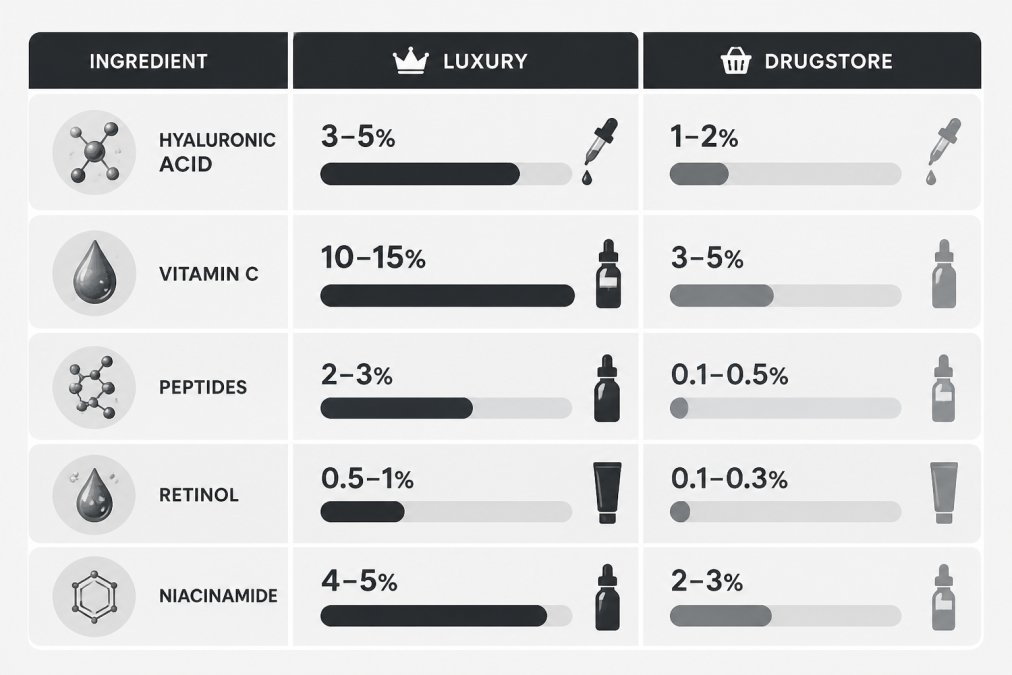
Many people assume luxury products use fundamentally different ingredients than drugstore options. The reality is more interesting: both tiers use the same active ingredients, but they differ in concentration, stability, and delivery mechanism.
Active ingredient potency and stability
Hyaluronic acid is hyaluronic acid whether you buy it for $16 or $50. But the concentration varies dramatically. A luxury moisturizer might use multi-molecular-weight hyaluronic acid at 3-5%, while a drugstore cream uses it at 1-2%.
Stability is equally important. Vitamin C oxidizes quickly and loses potency within weeks if not properly formulated. A luxury serum invests in stabilization technology, encapsulation, pH buffering, or antioxidant protection, to keep the vitamin C active for months.
Peptides illustrate this perfectly. The Anti-Aging Peptide Collection from Regnal Radiance uses 2% Hexapeptide-11, a concentration shown to reduce fine lines visibly. Many drugstore products include peptides at trace amounts, enough to list them on the label, not enough to deliver measurable results.

Formulation vehicles and absorption rates
How an ingredient reaches your skin matters as much as what the ingredient is. A luxury serum might use liposomal encapsulation to carry peptides through the skin barrier. A drugstore formula uses a basic water-and-glycerin base that sits on the surface longer.
Absorption speed affects both efficacy and user experience. A serum that absorbs in 30 seconds feels better than one that takes 5 minutes, and it allows you to layer other products without pilling. This requires more sophisticated formulation work.
Luxury brands also invest in sensory appeal, silky textures, pleasant scents, and lightweight feels that make skincare feel like a ritual rather than a chore. This matters more than it sounds.
Are Expensive Face Creams Worth It? Cost Per Use and Real-World Value
One way to evaluate whether luxury skincare is worth the price is to calculate cost per use. A $50 moisturizer that lasts 3 months (90 days) costs about $0.56 per day.
But cost per use only matters if both products deliver similar results. If the luxury cream reduces visible fine lines and the drugstore cream doesn't, the luxury option becomes the better value despite the higher daily cost.
The real question: does the luxury product deliver results you couldn't achieve with affordable alternatives? For sensitive skin prone to irritation, a luxury formula designed specifically for reactive skin might prevent months of inflammation and redness that would require dermatologist intervention.
For simple hydration needs, drugstore options often perform just as well. For targeted concerns like anti-aging, compromised barriers, or reactive skin, luxury formulations with higher active ingredient concentrations and specialized delivery systems tend to outperform.
Best Clean Beauty Brands 2026: When Premium Delivers Results
Clean beauty, skincare formulated without synthetic fragrances, parabens, sulfates, and unnecessary additives, has become mainstream.
Regnal Radiance represents the sweet spot: premium formulations with clean ingredient lists.
The Moisturizing Day Cream ($16.99) proves that clean, effective hydration doesn't require a premium price tag.
Anti-Aging Peptide Collection →

For anti-aging specifically, the Anti-Aging Peptide Collection ($48.30) delivers concentrated peptide technology designed to firm and smooth. At this price point and with this formulation focus, it delivers concentrated peptide technology.
Clean beauty brands justify premium pricing through ingredient sourcing, formulation safety, and efficacy testing. They cost more because they exclude cheaper synthetic fillers and focus on active ingredients that actually work.
Skin Type, Individual Needs, and When Premium Products May Be Worth the Splurge
Whether luxury skincare is worth the price depends almost entirely on your skin type and specific concerns. A one-size-fits-all answer doesn't exist.
Sensitive skin and reactive conditions
For sensitive skin, premium products often deliver better value than their drugstore equivalents. Sensitive skin reacts to fragrance, sulfates, and harsh preservatives. Luxury brands formulated specifically for reactive skin use gentler preservative systems and exclude common irritants entirely.
The Gentle Cleansing Milk from Regnal Radiance ($16.00) uses shea butter and argan oil instead of harsh surfactants. For someone with reactive skin, this $16 cleanser prevents the inflammation and tightness that cheaper cleansers trigger.
Similarly, the Body Luxury Bundle ($52.00) includes a Sensitive Skin Body Cream formulated with shea butter, cocoa butter, and aloe juice specifically for reactive skin. For someone whose skin reacts to most drugstore lotions, this premium option becomes necessary, not optional.
Mature skin and anti-aging concerns
Mature skin benefits most from higher active ingredient concentrations. Fine lines, loss of elasticity, and dullness respond to peptides, retinol, and vitamin C, but only at concentrations that deliver measurable change. Drugstore anti-aging products often include these actives at trace amounts insufficient to move the needle.
The Anti-Aging Peptide Collection ($48.30) uses 2% Hexapeptide-11, a concentration studied to improve skin firmness and reduce fine lines. A drugstore anti-aging cream might include peptides at 0.1%, which feels like anti-aging marketing without the efficacy. For someone over 40 serious about visible results, the luxury option delivers what the drugstore option promises but doesn't achieve.
Dehydrated and compromised skin barriers
Dehydrated skin needs more than water; it needs active hydration at multiple skin depths. The Moisturizing Day Cream uses multi-molecular-weight hyaluronic acid, different sizes of HA that work at different depths, to hydrate comprehensively. A basic drugstore moisturizer uses single-weight hyaluronic acid or skips it entirely.
For compromised skin barriers, luxury formulations with soothing actives like Bisabolol and protective antioxidants prevent further damage. A cheap moisturizer might hydrate temporarily but fail to support barrier repair. A premium formula does both.
Evidence for Product Effectiveness: What the Data Actually Shows
The honest truth: most skincare companies don't publish rigorous efficacy data. They conduct internal testing, show before-and-after photos, and rely on consumer reviews.
What does exist: ingredient-level research showing that hyaluronic acid hydrates skin, peptides improve elasticity, vitamin C brightens, and niacinamide soothes irritation. These are proven.
The most reliable evidence comes from concentration and formulation.
Consumer reviews help, but they're subjective. One person's "life-changing" serum is another person's "did nothing." Skin responds differently to different formulations based on individual skin type, barrier health, and existing routine.
The safest approach: start with options for your specific concern. If products deliver results, stick with them.
Conclusion: Making the Right Choice for Your Skin
Is luxury skincare worth the price? Sometimes. It depends on your skin type, your specific concerns, and whether affordable alternatives deliver the results you need.
For sensitive skin prone to irritation, clean luxury formulations prevent the inflammation and redness that cheaper products trigger.
The real value of luxury skincare lies in formulation sophistication: higher active ingredient concentrations, specialized delivery systems, and research-backed efficacy. When these features address your specific skin concerns, the premium price becomes an investment in results, not an indulgence.
If you're ready to invest in skincare that actually delivers, Regnal Radiance offers clean, science-backed formulations at genuinely premium quality. The Glow & Go Face Bundle simplifies your routine with four complementary essentials for hydration and brightness.

Frequently Asked Questions
What is the difference between luxury and drugstore skincare?
Luxury skincare typically contains higher concentrations of active ingredients, more advanced delivery systems, and formulations backed by extensive clinical testing. Drugstore options may use similar actives but often at lower concentrations or with less sophisticated stabilization. Luxury brands invest more in research and manufacturing precision, while drugstore lines prioritize affordability. The real difference depends on the specific product and your skin's needs, some drugstore moisturizers outperform luxury serums for certain skin types, while others genuinely benefit from premium formulations designed for sensitive or reactive skin.
Do expensive skincare products actually work better?
Not always. Price doesn't guarantee efficacy. A luxury cleanser may perform no better than a drugstore version if both contain similar cleansing agents. However, luxury skincare often excels in anti-aging serums, eye creams, and targeted treatments where ingredient concentration and formulation complexity matter. For basic hydration, a budget moisturizer with hyaluronic acid can be equally effective. The key is matching the product type to your skin concern, splurge on actives like peptides or retinol where concentration affects results, and save on basic cleansers and hydrating layers.
Are there clean beauty alternatives to luxury skincare?
Yes. Clean beauty brands in 2026 increasingly deliver premium results without the luxury price tag. Many offer formulations free from synthetic fragrances, parabens, and irritants while using high-quality active ingredients. Regnal Radiance, for example, combines clean ingredients with targeted actives like peptides and hyaluronic acid at mid-range pricing. The difference is that clean brands often skip expensive packaging and marketing, passing savings to you. Look for brands with transparent ingredient lists, third-party testing, and customer reviews confirming visible results, not just marketing claims.
When is luxury skincare worth the investment?
Invest in luxury skincare for sensitive, mature, or compromised skin where formulation precision directly affects tolerance and results. Luxury anti-aging collections with peptides, advanced retinol derivatives, or specialized eye creams justify higher costs because they're designed to minimize irritation while delivering potency. If you have reactive skin that has rejected multiple drugstore products, a dermatologist-tested luxury option may finally work. For basic cleansing and hydration on resilient skin, save money with budget-friendly alternatives and redirect spending to targeted treatments where premium formulation matters most.
How can I calculate cost per use to decide if a product is worth the price?
Divide the product price by the number of uses you'll get. A serum used twice daily for 3 months (180 uses) costs £0.27 per use. Another serum used the same way costs £0.07 per use, but if the luxury version lasts twice as long due to higher concentration, the cost per use equalizes. Also consider results: if a luxury cream reduces fine lines visibly in 4 weeks while a budget option takes 12 weeks, the premium product may deliver better value despite higher upfront cost. Track how long each product actually lasts in your routine, not just the bottle size.